How Long Do Security Screens Last? A Guide to Lifespan and Durability
What if you could install a protective shield over your home today and not have to worry about it again for the next quarter-century? Most homeowners naturally wonder how long do security screens last before they start to rust or lose their strength in the intense sun. It's a valid concern; nobody wants to invest in premium safety only to watch it fail after a few seasons of heat. You deserve a solution that acts as a permanent guardian for your family, not a flimsy temporary fix that needs replacing every few years.
We'll show you why a high-quality security screen is a multi-decade investment in your peace of mind. You'll discover exactly how many decades of protection you can expect from materials like 316 marine-grade stainless steel and how specialized powder coating creates a barrier that defies both intruders and the elements. We're also breaking down the critical differences between genuine security mesh and standard bug screens. We'll provide a clear maintenance checklist to help you maximize your investment and explain why specific steel grades are non-negotiable for real durability. By the end, you'll have total confidence in choosing a system that stays strong for the long haul.
Key Takeaways
- Learn why premium security screens offer a 20 to 30 year lifespan, providing a permanent solution that standard insect screens simply can't match.
- Discover the critical differences between 304 and 316 stainless steel and how the right material choice prevents corrosion in your specific climate.
- Master the "wash and wipe" routine and hardware care tips that keep your 3-point locking systems and hinges operating smoothly for decades.
- Understand exactly how long do security screens last when they're custom-engineered to your home's dimensions to prevent frame tension and premature wear.
- See how professional installation ensures structural integrity and even weight distribution to protect your investment for the long haul.
The Expected Lifespan: How Long Do Quality Security Screens Really Last?
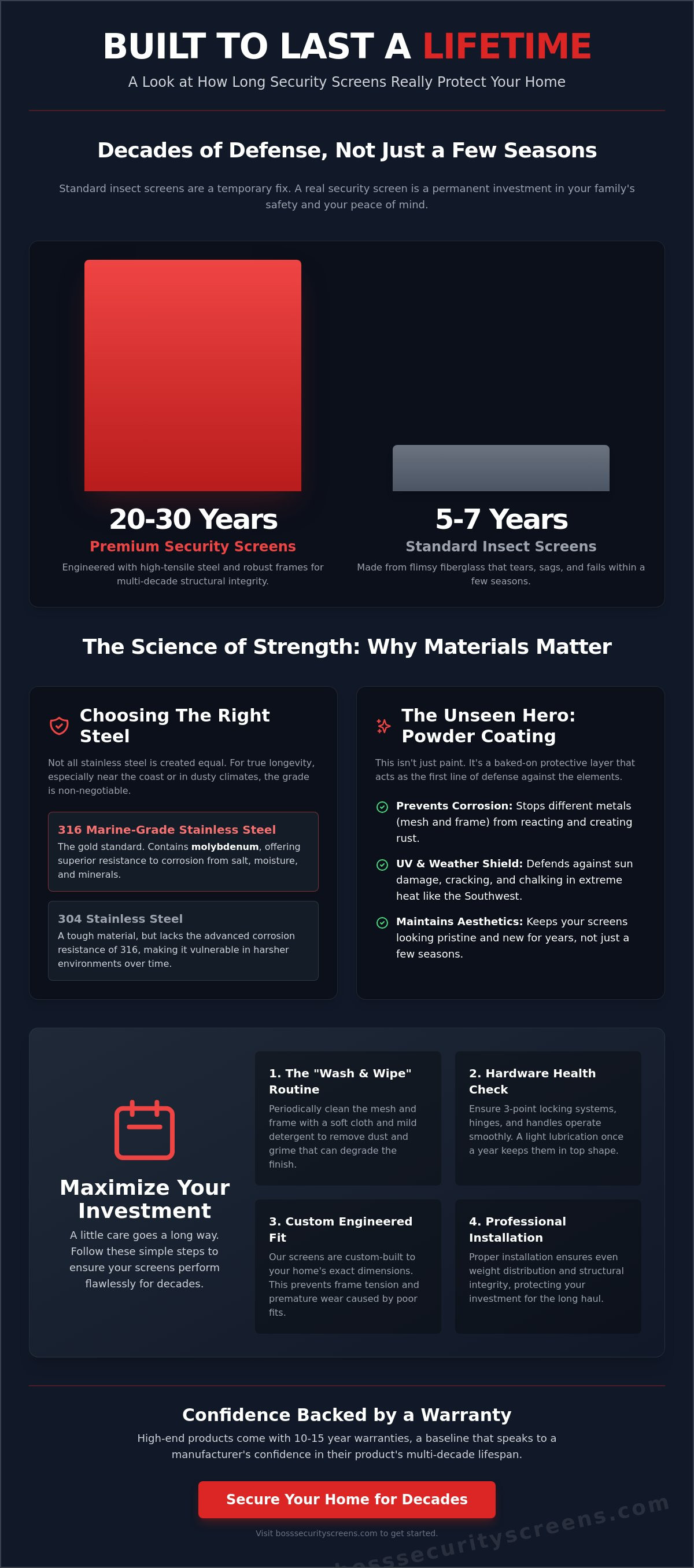
Most homeowners think of screens as flimsy mesh that tears if a cat looks at it too hard. Standard insect screens usually fail within five to seven years because they aren't built for stress. When you ask how long do security screens last, you're looking for a different level of performance entirely. High-quality security screens are engineered to endure for 20 to 30 years; some premium installations even reach the 50-year mark. We define security screen lifespan as the period where structural integrity remains 100% intact.
There's a big difference between a screen that looks old and one that fails to protect you. Aesthetic life refers to how long the powder coating stays pristine. Functional life is the screen's ability to stop an intruder. A screen might show some surface wear after two decades of desert sun, but its physical hardiness remains unchanged. It stays a tough, sophisticated guardian for your home long after cheaper alternatives have crumbled.
Security Mesh vs. Traditional Window Screens
Traditional screens use fiberglass or thin aluminum that sags and tears under the slightest pressure. In contrast, security window screens utilize high-tensile stainless steel mesh. This material doesn't just keep bugs out; it acts as a structural barrier. When researching window security measures, it's clear that physical resilience is what separates a true security product from a simple barrier. These screens won't tear or sag even after years of environmental stress.
The Role of Warranties in Predicting Longevity
A manufacturer's warranty is a window into their own confidence. Most high-end products come with a 10 to 15-year warranty. This serves as a baseline for the expected how long do security screens last calculation. You need to read the fine print carefully. Does the coverage include corrosion and UV fading, or does it only cover the locks and hinges? A comprehensive warranty on security doors proves the brand expects the product to survive the harshest conditions without losing its protective edge.
Why Material Grade and Climate Dictate Durability
Choosing the right metal for your home isn't just about strength; it's about chemistry. When people ask how long do security screens last, the answer depends heavily on whether they're using 304 or 316 marine-grade stainless steel. While 304 is tough, 316 contains molybdenum, which provides superior resistance to corrosion. This is vital if you live near the coast, but it's equally important in the desert where dust and minerals can eat away at inferior metals. Following the industry standard for security screens ensures that your investment won't just look good today, but will remain structurally sound for decades.
Powder coating is the invisible hero of this equation. It isn't just paint; it's a baked-on protective layer that prevents galvanic corrosion. This occurs when two different metals, like the mesh and the frame, touch and create a chemical reaction that leads to rust. A high-quality finish also shields the screen from intense UV rays. In cities like Las Vegas or Phoenix, temperatures can swing wildly, causing materials to expand and contract. Without a premium finish, this stress leads to "chalking" or cracking, which invites moisture and failure. This is why material choice is a non-negotiable priority for long-term safety.
Weather Resistance in the American Southwest
The Southwest presents unique challenges for home protection. Intense UV exposure can turn cheap door finishes into a powdery mess in just a few years. High-grade finishes prevent this degradation, keeping your security doors looking sharp. Additionally, high-tensile mesh is naturally resistant to the abrasive force of wind-blown sand. While aluminum bug screens might tear or pit under these conditions, stainless steel mesh remains unyielding and maintains its visual clarity.
Structural Integrity and Frame Construction
The frame is the backbone of your protection. We use heavy-duty extruded aluminum frames rather than flimsy roll-formed steel that can warp over time. A critical feature is the internal "grip" system. This mechanical lock holds the mesh under constant tension, preventing the sagging often seen in low-quality products after 10 years. If you're curious about how these features fit your home, it's easy to schedule a professional assessment to see the difference in person.
Maintenance and Care: How to Make Your Screens Last a Lifetime
Maintaining your security screens is the difference between a 15-year product and a 30-year legacy. While the build quality determines the baseline, your care routine ultimately determines how long do security screens last in real-world conditions. A simple "wash and wipe" routine prevents environmental pollutants from attacking the protective powder coating. Use a soft cloth, warm water, and a mild, non-acidic detergent to remove surface contaminants before they can bond to the mesh. This small effort keeps the barrier looking pristine and functioning at peak strength.
Hardware health is just as critical as mesh integrity. Your security doors likely feature a sophisticated 3-point locking system designed for maximum resistance. These mechanical components require a quick check every few months to ensure they remain smooth and responsive. If the key feels sticky or the latch doesn't click with authority, it's time for a quick clean. Use a dry silicone spray for lubrication; avoid heavy oils or grease, as these attract the very dust you're trying to keep out. Catching a stiff lock early prevents a total hardware failure later.
Cleaning Schedules by Location
Your environment dictates your cleaning frequency. In arid regions like Phoenix or Las Vegas, high-alkaline dust can accumulate in the tracks and mesh. A thorough cleaning every three to four months is usually sufficient to keep everything moving. However, if you're in coastal areas like San Diego or Irvine, salt is your primary enemy. Salt spray can be relentless and corrosive, so a quick rinse every two to four weeks is necessary to prevent salt crusting from compromising the finish of your security window screens.
What NOT to Do with Your Security Screens
Avoid the temptation to use a high-pressure washer on your screens. The intense force can actually damage the seals or the precision bond between the mesh and the frame. Similarly, stay away from abrasive scouring pads or harsh chemicals that can scratch the factory-applied powder coating. Never attempt to paint over the screen; doing so ruins the visual clarity and can trap moisture against the metal. If you're unsure about the current state of your home protection, you can always schedule a free consultation to have an expert evaluate your screens.
The Boss Difference: Engineering Longevity for Your Home
Off-the-shelf products often force a "close enough" fit that creates gaps or puts unnecessary stress on the door frame. We take a different approach. By engineering every screen to the exact specifications of your home, we eliminate the frame stress that leads to premature wear. When considering how long do security screens last, the precision of the fit is just as vital as the strength of the steel. A perfect seal means no rattling, no sagging, and no weak points for an intruder to exploit. It's the difference between a temporary barrier and a permanent architectural upgrade.
Why Professional Installation Matters
A screen is only as strong as its connection to your home. Professional installation ensures the structural load is distributed evenly across your home's framing, preventing "frame racking." This is a common issue where a poorly fitted door shifts over time, causing lock misalignment and hardware failure. Our team uses specific anchoring techniques tailored to your home's material, whether it's stucco, brick, or siding. This structural integrity is the biggest factor in how long do security screens last when faced with daily use and the occasional attempted breach. We don't just hang a door; we integrate a shield into your home's foundation.
Investing in Permanent Security
Think of security window screens as a one-time home improvement rather than a recurring expense. When you compare the upfront cost to twenty years of monthly alarm monitoring fees, the long-term ROI is clear. We build our screens with a "Guardian" philosophy. We want them to look and function as well in 2046 as they do the day they're installed in 2026. It's about moving from a state of constant concern to a state of total confidence. Our commitment to quality means your home remains a sanctuary without sacrificing its curb appeal. Ready for a screen that lasts? Schedule your free consultation today and see how we provide the peace of mind your family deserves.
Invest in Permanent Peace of Mind
Investing in your home's safety shouldn't be a recurring chore that you have to revisit every few years. By now, you understand that how long do security screens last depends on the synergy of high-tensile 316 stainless steel and a consistent maintenance schedule. When you choose materials specifically designed to withstand the brutal Southwest sun and corrosive salt air, you're moving from a temporary fix to a permanent guardian for your family. Architectural-grade powder coating and a simple "wash and wipe" routine ensure your screens remain as resilient and attractive as the day they were installed.
The final piece of the structural puzzle is the precision of the fit. Custom-built in the USA and professionally installed by local experts, our screens eliminate the frame stress that causes off-the-shelf products to fail prematurely. You aren't just buying a physical barrier; you're securing a lifetime of comfort and confidence. It's time to stop worrying about rust, UV damage, or sagging mesh. Take the next step toward a home that stays protected through every season and every decade.
Secure your home for a lifetime with a Free Consultation
Frequently Asked Questions
Do security screens rust over time?
High-quality security screens are designed to resist rust for decades. While standard mesh might corrode within a few years, premium 316 marine-grade stainless steel contains molybdenum to block chemical attacks from salt and moisture. When this steel is paired with an architectural-grade powder coating, it creates a powerful barrier that prevents oxidation. This ensures your home remains protected without the unsightly orange streaks of corrosion.
How often should I clean my security window screens?
Your cleaning schedule depends entirely on your local environment. For homes in arid regions with high dust levels, a thorough wash every three to four months is sufficient to maintain clarity. If you're within five miles of the ocean, you'll need to rinse your screens every two to four weeks to prevent salt buildup. Regular maintenance is the most effective way to extend how long do security screens last.
Can security screens withstand extreme desert heat?
Yes, professional-grade screens are engineered specifically for the intense UV and heat found in the Southwest. Unlike fiberglass that becomes brittle and snaps under the sun, high-tensile steel maintains its structural integrity at high temperatures. The heavy-duty extruded aluminum frames also handle thermal expansion without warping. This ensures the screen remains a tough, sophisticated guardian for your home even during record-breaking heatwaves.
What is the difference between 304 and 316 stainless steel mesh?
The main difference lies in chemical composition and environmental resilience. While 304 stainless steel is incredibly strong, 316 stainless steel includes molybdenum, which makes it significantly more resistant to salt and industrial pollutants. If you want to maximize how long do security screens last, 316 is the gold standard for long-term durability. It provides the relief of a permanent solution regardless of your local climate.
Will my security screen mesh sag after a few years?
No, a properly engineered security screen will never sag or lose its tension over time. This longevity comes from the mechanical "grip" system that locks the mesh into the frame under high pressure. Unlike standard screens that rely on a simple rubber spline, these professional systems ensure the mesh remains tight and impact-resistant for its entire 20 to 30-year lifespan. You won't have to worry about flimsy, drooping mesh ever again.