
Which Is Better — Home Alarm or Physical Barrier?
When people think about home security, they usually picture flashing lights, sirens, and camera feeds.
But if you talk to a police officer or insurance adjuster, they’ll tell you: most crimes are over long before the alarm ever sounds.
That raises an uncomfortable question — are digital alarms enough, or do physical barriers work better?
How Break-Ins Actually Happen
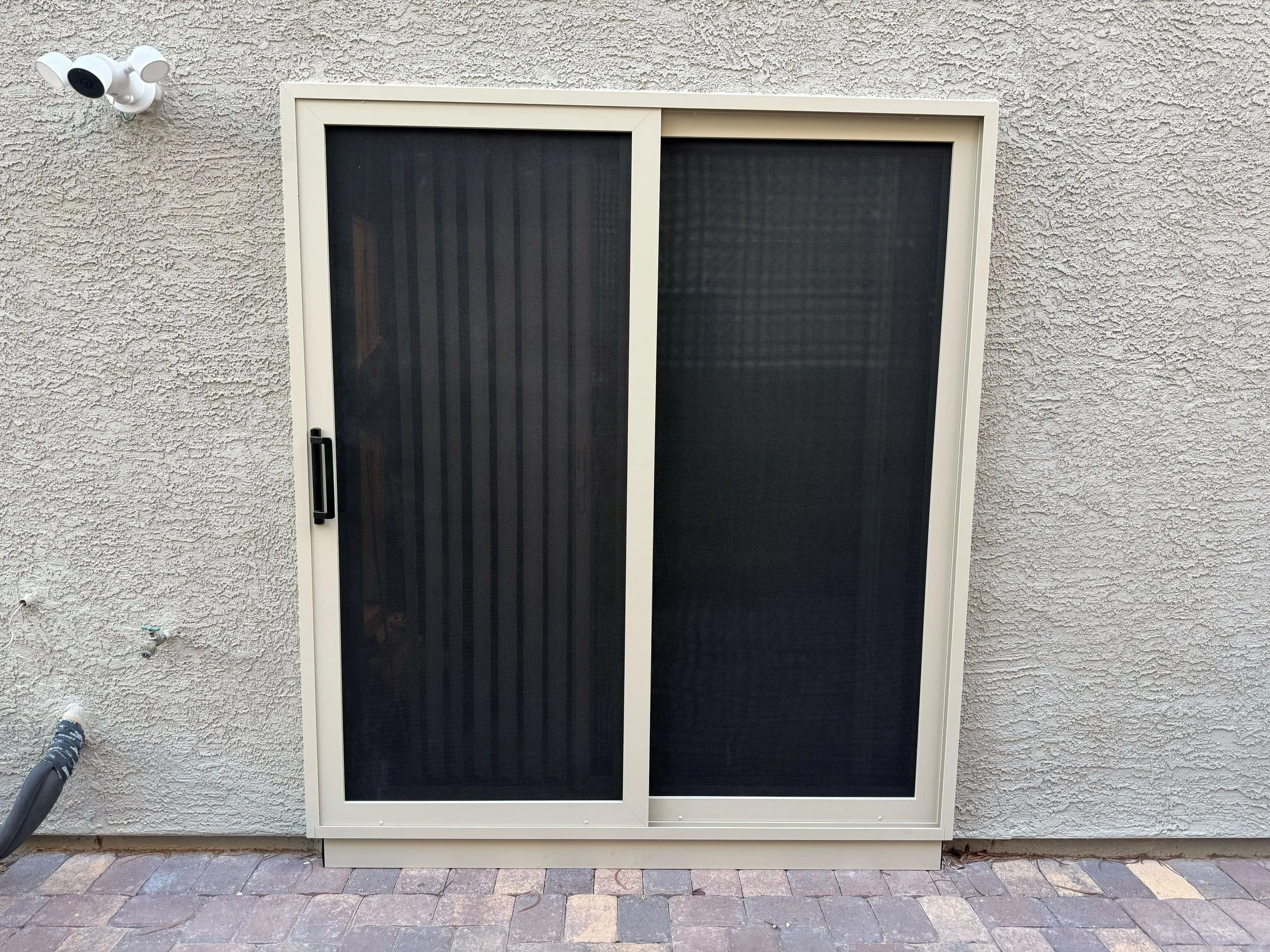
According to the FBI Uniform Crime Report (2023), more than 57 % of residential burglaries begin with forced entry through a door or window.
The average burglary lasts under 90 seconds — far faster than any police response time.
So, while alarms are valuable for evidence and alerts, the first minute decides the outcome.
The only thing that can stop an intruder during that window is a physical obstacle.
What the Data Shows
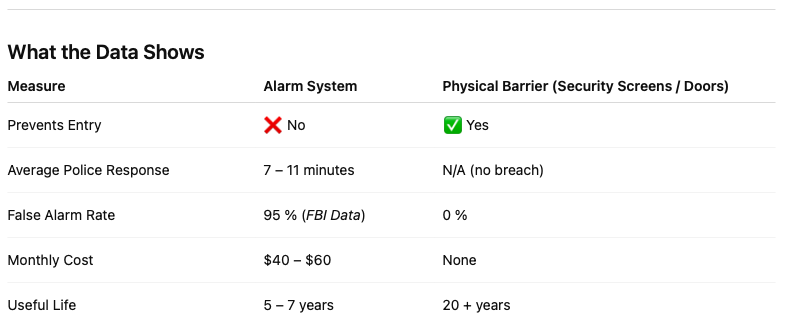
A Rutgers University School of Criminal Justice study found homes with visible security measures had 60 % fewer break-ins — but the most powerful deterrents were physical, not electronic.
Why Alarms Fail as First-Line Defense
Time Delay:
Even when an alarm triggers instantly, police often take 10 minutes or more to arrive. Most burglars are gone in two.False Alarm Fatigue:
The FBI Law Enforcement Bulletin estimates over 90 % of alarm calls are false. Many jurisdictions now fine homeowners for repeat false triggers, and some delay dispatch until verification.No Physical Resistance:
Alarms make noise; they don’t stop a door from opening. By the time they activate, entry has already occurred.Dependence on Power & Connectivity:
Outages, battery failures, or weak Wi-Fi render alarms temporarily useless. A mechanical barrier never goes offline.
What Physical Barriers Do Differently
Physical barriers — reinforced doors, window security screens, and tamper-proof locks — operate on a simpler principle: make entry physically impossible or painfully slow.
Every extra second an intruder struggles increases their chance of being seen or caught.
Criminal behavior studies call this the “time-to-failure deterrent” — most burglars abandon the attempt after 30 seconds of resistance.
Security screens, like those built by Boss Security Screens, pass impact tests exceeding 220 joules, knife-shear, and jemmy-pry standards (AS5039 / ASTM F1233). In other words, you can kick, cut, and pry — and still not get through.
Real-World Scenario: Henderson vs. Henderson
Two homes in the same Las Vegas suburb had very different outcomes.
House A: Traditional alarm system, cameras, no physical reinforcement.
– Intruder kicked open the rear door in 15 seconds.
– Police arrived 9 minutes later.
– Losses: ≈ $18,000.House B: Security screens on all doors and windows, motion lights, no monitored alarm.
– Intruder attempted entry, failed to pry mesh.
– Left visible damage ($300 repair) but no loss.
– Police found discarded crowbar nearby.
Prevention > notification.
Synergy: The Layered Approach
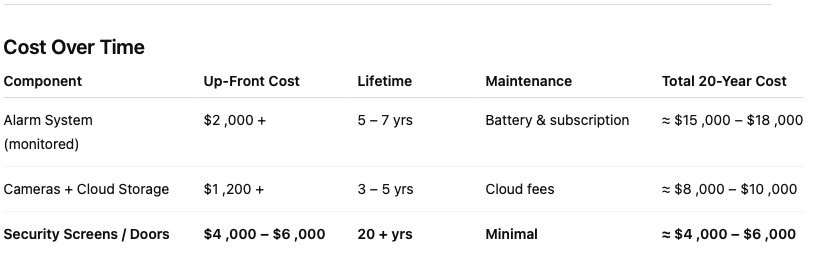
It’s not about choosing one or the other. The best protection comes from layered security.
Physical layer: Security doors, screens, and locks.
Visual layer: Cameras, motion lighting.
Alert layer: Monitored or self-notification alarms.
Each covers the others’ weaknesses — but without that first physical layer, the rest only react after the breach.
The Psychology of Deterrence
Interviews with convicted burglars (University of North Carolina at Charlotte, 2022) reveal that visibility of strength — metal doors, reinforced frames, and security mesh — discourages attempts more than any sign or siren.
When asked which would stop them, 83 % chose “bars or metal screens” over alarms.
Criminals don’t like noise, but they hate wasted effort.
Expert Insight
According to Boss Security Screens, the most overlooked metric is prevention time.
“The goal isn’t to scare someone away after they’re inside — it’s to make sure they never get in,” says their technical team.
“Electronic systems help with evidence. Physical systems prevent trauma.”
Complementary Benefits
Security screens and doors also:
Provide ventilation while locked — important in hot climates.
Offer daytime privacy and glare reduction.
Reduce insurance premiums (many carriers classify them as hardening improvements).
Require zero electricity and work during outages.
So while alarms keep you informed, screens keep you safe.
The Practical Formula
For most homeowners, the ideal balance looks like this:
80 % budget → physical protection (doors, screens, locks)
20 % budget → electronic alerting (smart cameras, motion sensors)
That ratio aligns with the Pareto Principle — 80 % of your security comes from the 20 % of actions that physically stop entry.
Conclusion
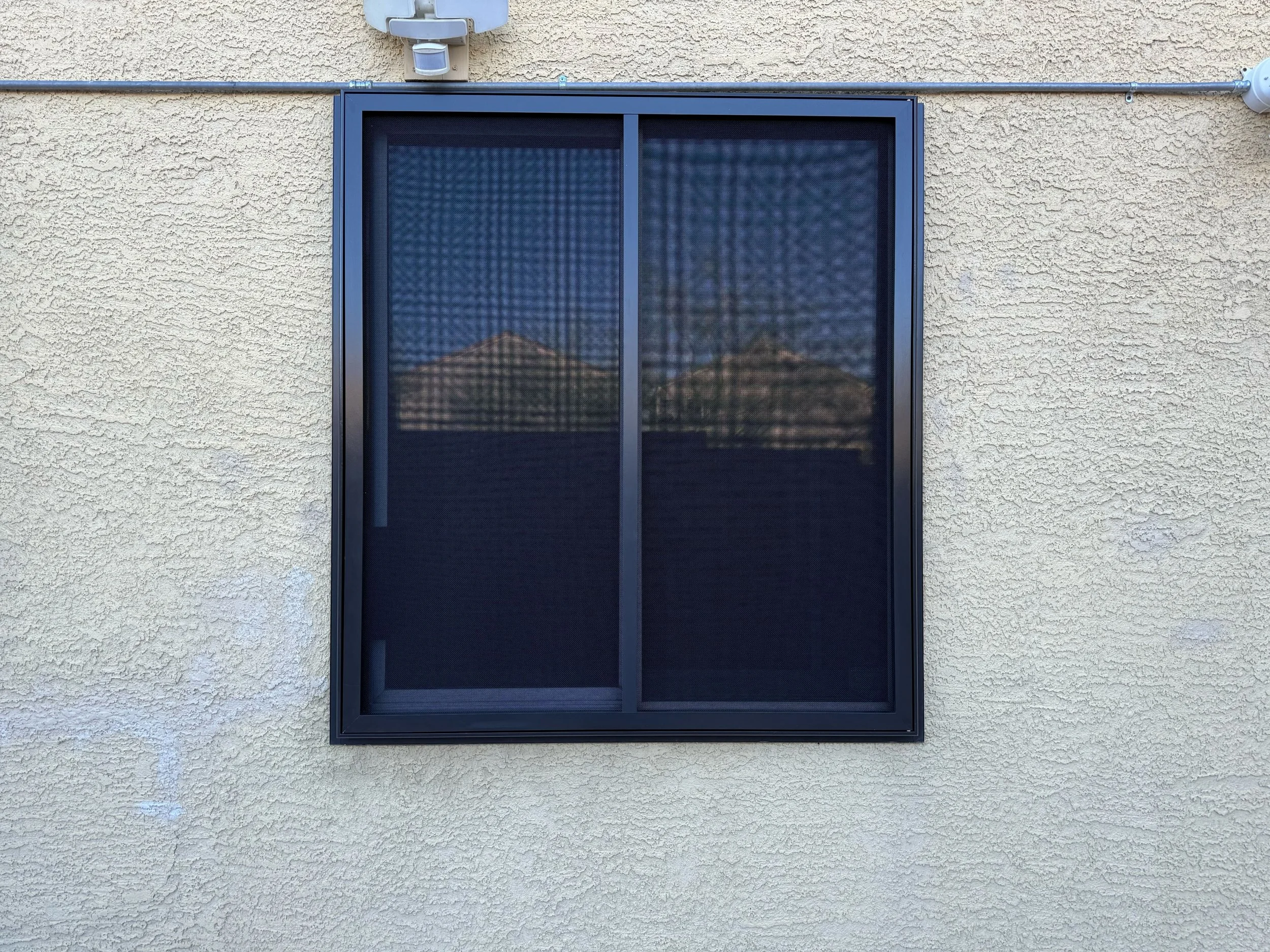
Alarms are a good backup.
But real protection starts with barriers that buy time, stop force, and deny access altogether.
If an intruder can’t get in, they can’t do harm — and that’s the ultimate measure of security.
A quiet, strong door may not look impressive on a smartphone app, but when someone tries it in the middle of the night and fails… that’s the only alert you’ll ever need.