Homeowner Association Window Rules: The 2026 Guide to Upgrades & Security
What if the rules meant to protect your property value are the same ones keeping your family at risk? It's a common dilemma for residents who want to upgrade their protection but feel trapped by restrictive homeowner association window rules. You likely worry that a necessary security upgrade will result in a heavy fine or an industrial look that ruins your home's aesthetic. We understand that frustration. You shouldn't have to choose between a safe home and a beautiful one.
This guide provides a clear path to getting your security upgrades approved without the headache. We'll show you how to manage the 2026 regulatory landscape, including new protections in states like Florida and Arizona that favor homeowner safety. You'll learn the specific strategies to present your project to the board and discover high-tensile security screens that offer invisible protection. We're going to break down the approval process and highlight solutions that provide total peace of mind while satisfying even the strictest architectural review committees.
Key Takeaways
- Learn why communities enforce a "Uniformity Standard" and how it protects your property value while creating specific boundaries for upgrades.
- Master the process of navigating homeowner association window rules by following a clear, step-by-step submission strategy for architectural approval.
- Understand the "Reasonableness Test" and how current legal trends in states like California and Arizona support your right to home security.
- Discover how to present security window screens as "invisible" solutions that maintain curb appeal and satisfy even the strictest board members.
- Get practical tips on using technical specifications and material samples to prove your security upgrades won't look industrial or out of place.
Why HOAs Have Rules for Windows and Screens
A Homeowner association (HOA) exists to protect your most significant investment: your home. This protection often manifests as strict homeowner association window rules designed to maintain architectural integrity across the community. In cities like Scottsdale and Irvine, these standards ensure every property contributes to a cohesive visual narrative. When one house installs shiny reflective film or bulky bars, it disrupts the "Uniformity Standard." This standard exists to prevent visual clutter that could negatively impact the market value of every home on the block. Understanding homeowner association window rules is the first step toward a successful security upgrade.
Common Restrictions You'll Encounter
You'll typically find limitations on frame colors and materials to prevent a mismatched appearance. For example, a board might require bronze frames to match a Mediterranean theme while prohibiting white vinyl. Street-facing windows often face "muntin" requirements, which are the grid patterns that give windows a traditional look. Most associations also ban reflective films or dark exterior solar screens because they alter the home's "face" in a way that looks inconsistent with the neighborhood's established curb appeal. This focus on a professional and uniform appearance is similar to how local businesses utilize Yeahgor Commercial Wraps & Decals to maintain a high-quality, consistent brand image for their fleet vehicles.
The Legal Hierarchy of HOA Documents
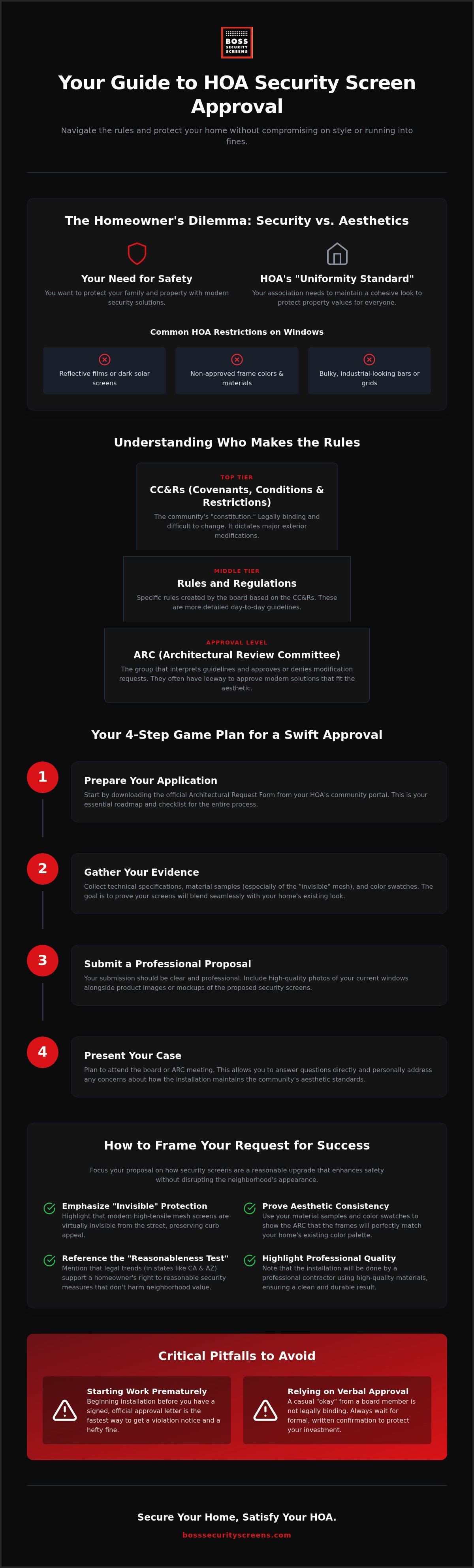
It helps to think of your community documents as a pyramid. At the top sits the CC&Rs, which act as the constitution for your neighborhood. CC&Rs are the legally binding document that dictates exterior modifications. Below that, you'll find the specific "Rules and Regulations" created by the board. The Architectural Review Committee (ARC) uses these documents to interpret vague guidelines. While the CC&Rs are difficult to change, the ARC often has the authority to approve modern solutions, like security window screens, if they meet the community's aesthetic standards. This hierarchy ensures that every change is deliberate and documented.
Navigating the HOA Architectural Review Process
Getting your security upgrades approved is a straightforward process when you follow the right steps. While the legal authority of HOAs allows them to set strict standards, most boards are reasonable if you provide clear documentation. Start by downloading the official Architectural Request Form from your community portal. This document is your roadmap. You'll need to gather technical specifications, including material samples and color swatches, to prove your new screens match the existing aesthetic. Submit a formal proposal that includes high-quality photos of your current windows alongside the proposed upgrades. Finally, plan to attend the board or ARC meeting. This is your chance to address concerns about how the installation maintains the "Uniformity Standard" mentioned earlier.
What the ARC Looks for in a Proposal
The Architectural Review Committee prioritizes consistency. They want to ensure your upgrade respects the original builder's design and color palette. They also evaluate the professionalism of your contractor and the quality of the materials used. High-tensile steel mesh is often approved because it doesn't negatively impact the exterior "envelope" of the building. To ensure your project stays within budget while meeting these high standards, you can check our pricing page for professional-grade options.
Avoiding Common Approval Pitfalls
Don't make the mistake of starting work before you have a signed approval letter. Beginning an installation early is a fast track to a "notice of violation" and potential fines. Even if a board member gives you a verbal "okay" during a casual chat, it isn't legally binding. Always get your approval in writing to protect your investment. Following these homeowner association window rules ensures your home stays secure without the stress of a legal dispute. If you're feeling overwhelmed by the paperwork, a free consultation can help you gather the specific technical details your board will want to see.
Can an HOA Legally Deny Security Window Screens?
While boards have significant power, they don't have absolute authority to ignore your family's safety. Courts in states like California and Arizona often apply a "Reasonableness Test" to determine if a board's decision is fair. If your request follows the established homeowner association window rules and doesn't negatively impact the neighborhood's look, a flat denial might not hold up legally. This is where a Guide to Architectural Control becomes essential. It explains how governing documents must be applied consistently rather than at the whim of a board member.
The most common objection homeowners face is the claim that security measures look like "burglar bars." This is a dated perspective. High-tensile steel mesh has changed the game by offering a sleek profile that mimics a standard insect screen from the curb. Unlike permanent bars, these screens often feature a quick-release mechanism. This is a critical safety feature for fire egress that many associations actually require once they understand the technology. You're replacing a potential liability with a life-saving asset.
Balancing Safety with Community Standards
Frame your upgrade as a necessary protective layer for your household. You aren't changing the architecture; you're hardening it against intrusion. Modern security screens maintain 97% visibility while providing 100% protection. This "invisible" factor is your strongest argument. It proves that you can secure your home's perimeter without altering the visual "envelope" the board is sworn to protect. By choosing a solution that prioritizes aesthetic clarity, you remove the board's primary reason for saying no.
What to Do If Your Request is Denied
If you receive a denial, don't panic. You can request a formal "Variance" based on specific security concerns or recent incidents in your immediate area. It's also helpful to provide photos of similar approved projects in nearby communities to show that your request is standard for modern homes. If you need help gathering the right technical evidence to challenge a decision, consult with our experts for help with HOA documentation. We can provide the material specs and safety data needed to turn a "no" into a "yes." Following the right homeowner association window rules is easier when you have a professional partner in your corner.
How to Get Your Security Screens Approved Every Time
Winning over an Architectural Review Committee requires a strategy that balances safety with style. You aren't just asking for permission. You're presenting a premium upgrade that enhances the community's overall appeal. Boss Security Screens are designed to be the ultimate "invisible" solution. From the street, these screens look identical to standard insect screens. This visual clarity is your strongest tool when navigating homeowner association window rules. Boards in cities like Las Vegas and Phoenix are much more likely to approve a project when they see professional renderings showing a seamless, integrated fit.
Highlight the property value angle during your presentation. Quality security is a premium feature that modern buyers value. It's an investment in the home's integrity that provides a permanent safety solution. You should also emphasize the "Quick Release" safety latch. This feature satisfies strict fire department egress codes. It proves that your upgrade prioritizes life safety alongside physical protection. When you show the board that your screens are as safe as they are strong, you remove their reasons to say no.
The Boss Advantage for HOA Compliance
We provide custom color-matching for frames to ensure 100% uniformity with your specific HOA palette. Our professional installation meets all local building codes and structural standards. This level of detail removes the guesswork for the board. They want to know the work will be done right and look perfect. You can explore our security window screens that are specifically engineered for HOA-governed neighborhoods to see how we maintain that balance.
Final Checklist Before Your ARC Submission
Before you hit "send" on that application, double-check your documentation. Confirm your contractor is licensed and insured in your specific state, whether that is Nevada, Arizona, or California. Your proposal should also include a "no-alteration" guarantee. This assures the board that the window's original function and frame remain intact. For a deeper look at location-specific tips, read our Security Screens Las Vegas: The 2026 Homeowner’s Guide. Following these homeowner association window rules ensures your home is protected without any legal friction or community pushback.
Protecting Your Perimeter with Confidence
Securing your family shouldn't feel like a legal battle. By understanding the specific homeowner association window rules in your community, you can upgrade your home's defense without sacrificing its curb appeal. We've explored how modern high-tensile mesh provides a nearly invisible barrier that satisfies even the toughest architectural boards. You now have the strategy needed to present your project as a safety asset rather than an aesthetic liability. It's time to replace uncertainty with a permanent security solution that respects your neighborhood's standards.
Our team specializes in making this process seamless. We offer custom-built screens designed for perfect aesthetic integration and provide expert assistance with your HOA approval documents. Whether you need professional installation in Las Vegas, Phoenix, or across California, we ensure your home meets all structural and safety codes. Don't wait for a vulnerability to become a crisis. Get a Free Consultation for Your HOA-Approved Security Solution today. You deserve the peace of mind that comes with a home that is both beautiful and unbreakable.
Frequently Asked Questions
Can my HOA force me to remove security screens if I didn't get approval?
Yes, your HOA can legally require the removal of any modification that hasn't gone through the architectural review process. This often results in a cease-and-desist letter or daily fines until the property is restored to its original state. It's always safer to pause and get written permission first. If you're already in this situation, you should immediately submit a formal application for retroactive approval to prove the upgrade meets community standards.
Do security window screens count as 'bars' under HOA rules?
Technically, no. Modern high-tensile mesh screens are designed to be an "invisible" solution that mimics standard insect screens. Unlike traditional bars, these screens don't alter the building's envelope or create an industrial look. They also include mandatory quick-release mechanisms for fire safety. When you're explaining your project, avoid the word "bars" to ensure you stay within the established homeowner association window rules for your specific neighborhood.
How do I find out my specific HOA's window and screen regulations?
You can find these details in your community's governing documents, specifically the CC&Rs and the Architectural Review Committee (ARC) guidelines. These are typically available on your resident portal or through the property management office. Look for sections regarding "exterior appearances" or "windows and doors." These rules provide the technical specs for frame materials and color palettes that the board expects you to follow for any street-facing modifications.
What happens if my HOA denies my request for security upgrades?
A denial isn't necessarily the end of the road. You can request a variance or a formal appeal hearing with the board. In states like Florida, the HOA must provide a written explanation citing the exact rule you've violated. Use this information to refine your proposal. Providing material samples or showing that your security window screens look identical to standard screens can help you win over a skeptical committee.