Security Screens Cost: The 2026 Homeowner’s Guide to Protection and Value
The cheapest security screen you can buy might be the most expensive mistake you ever make. That's not a scare tactic; it's a structural reality. A screen that looks the part but folds under a firm kick isn't security. It's theater. And when you're researching security screens cost, the price gap between a big-box store option and a custom professional solution can feel genuinely confusing, even frustrating.
You're not alone in that frustration. Most homeowners want the same thing: real protection that doesn't make their home look like a fortress, at a price that actually makes sense. The problem is that the market is full of products that charge for appearance while delivering very little in the way of genuine resistance.
This guide cuts through all of that. You'll get a clear, honest breakdown of what professional-grade security screens actually cost for doors and windows, why the right materials like 304 stainless steel mesh matter more than the price tag alone, and how a single smart investment can protect your family for 20 years or more without a monthly fee in sight. Let's get into it.
Key Takeaways
- Understanding security screens cost means looking beyond the sticker price — a $600 budget door and a $2,500 professional-grade screen are not the same product, and this guide shows you exactly why.
- Material and frame engineering are the real drivers of price: 304 stainless steel mesh and architectural-grade aluminum frames are what separate genuine protection from a product that only looks secure.
- Big-box and budget iron options carry hidden costs — separate locksets, installation fees, and ongoing rust maintenance — that quietly erase any upfront savings.
- A professional security screen can eliminate the need for monthly alarm monitoring fees while also lowering cooling costs, making it one of the smartest long-term investments a homeowner can make.
- French doors and large sliding glass door configurations start at a higher price point due to complexity, but the 20-plus year lifespan of quality materials means the math works firmly in your favor.
2026 Price Breakdown: What Do Security Screens Cost?
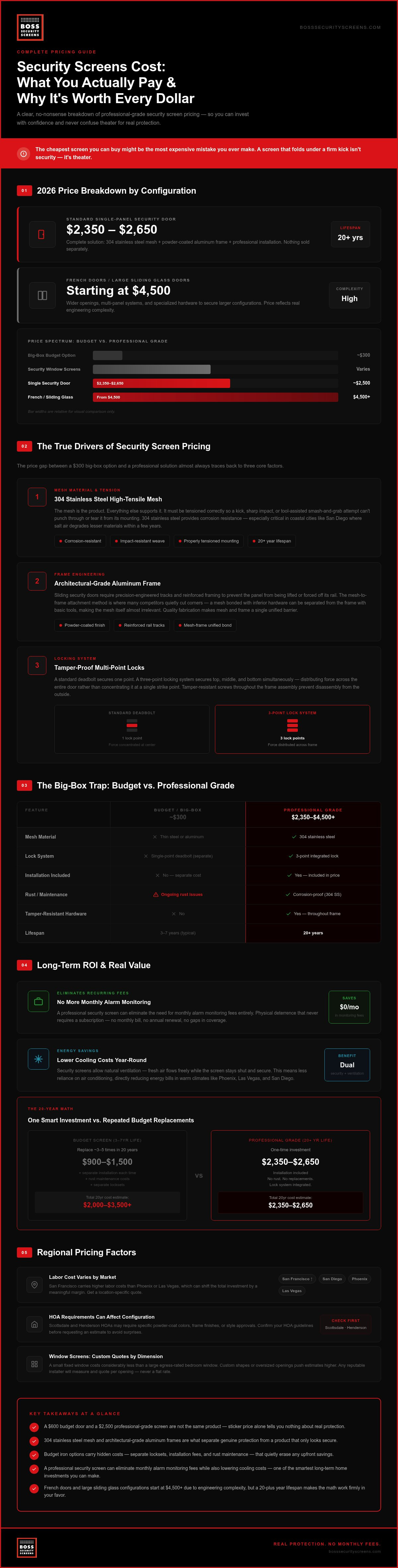
Let's talk real numbers. A standard single-panel security screen door from a professional installer runs between $2,350 and $2,650. That range reflects a complete solution: high-tensile 304 stainless steel mesh, a powder-coated architectural aluminum frame, and professional installation. Nothing is sold separately. Nothing is left to chance.
Step up to a more complex configuration and the price shifts accordingly. French security doors and large sliding glass door solutions start at approximately $4,500. That's not an arbitrary jump. It reflects the engineering complexity involved in securing wider openings, multi-panel systems, and the specialized hardware required to make those configurations genuinely resistant rather than just visually convincing.
Security screens cost more when the job is harder. That's honest, and it's fair.
Cost by Configuration: Doors vs. Windows
Entry doors and security window screens occupy different price brackets for good reason. Sliding security doors require precision-engineered tracks and reinforced framing to prevent the panel from being lifted or forced off its rail, which adds both material and labor cost. Window screens, by contrast, are priced based on dimensions and egress requirements specific to each opening. A small fixed window costs considerably less than a large egress-rated bedroom window. Custom shapes or oversized openings will push the estimate higher, and any reputable installer will measure and quote accordingly rather than offering a flat rate that doesn't account for your actual home.
Regional Pricing Factors in the Southwest
Where you live influences what you'll pay for installation labor. Markets like San Francisco carry higher labor costs than Phoenix or Las Vegas, which can shift the total investment by a meaningful margin. HOA requirements in communities across Scottsdale and Henderson add another layer of consideration: specific powder-coat colors, frame finishes, or style approvals can affect which configurations are available to you and how the final quote is structured. It's worth confirming your HOA's guidelines before requesting an estimate so there are no surprises at the finish line.
For a detailed breakdown tailored to your specific configuration, the pricing page is the clearest starting point.
The True Drivers of Security Screen Pricing
Price doesn't come from nowhere. When you're comparing security screens cost across different providers, the gap between a $300 big-box option and a professionally installed solution almost always traces back to three things: what the mesh is made of, how the frame is engineered, and whether the locking system was designed to actually stop someone or just slow them down for a second.
Here's what's actually driving that number.
High-Tensile Mesh and Structural Integrity
The mesh is the product. Everything else supports it. A woven, high-tensile mesh has to be tensioned correctly across the frame so that a sharp impact, a kick, or a tool-assisted "smash and grab" attempt can't punch through or tear it from its mounting. Loose or improperly tensioned mesh defeats the entire purpose, regardless of what it's made from.
304 stainless steel is the industry standard for corrosion resistance, which matters especially in coastal cities like San Diego where salt air degrades lesser materials within a few years. It's also what makes the 20-plus year lifespan realistic rather than aspirational. The mesh-to-frame attachment method is where a lot of competitors quietly cut corners. A mesh that's bonded or clamped with inferior hardware can be separated from the frame with basic tools, which makes the mesh itself almost irrelevant. Quality fabrication means the mesh and frame function as a single, unified barrier.
Tamper-Proof Hardware and Multi-Point Locks
A standard deadbolt secures one point. A three-point locking system secures the top, middle, and bottom of the frame simultaneously, which distributes force across the entire door rather than concentrating it at a single strike point. That engineering difference is a meaningful cost driver.
High-grade security doors also use tamper-resistant screws throughout the frame assembly, so the frame itself can't be disassembled from the outside. Internal keyed mechanisms keep locking hardware inaccessible to anyone standing on the exterior. These aren't premium add-ons. They're structural requirements for a product that's actually meant to hold.
Custom fabrication matters here too. An off-the-shelf screen that doesn't fit your opening precisely creates gaps at the frame perimeter, and gaps are vulnerabilities. Custom-built means the screen is made for your exact dimensions, eliminating the weak points that standard sizing leaves behind. If you want to understand how these factors apply to your specific configuration, talking through the details with an expert is the clearest next step.
The Big Box Trap: Professional Grade vs. Budget Iron
A $600 iron door from a big-box retailer looks like a deal. On paper, it is. In practice, it's the beginning of a longer, more expensive relationship than most homeowners expect.
Here's what that sticker price typically doesn't include: a lockset (sold separately), a handyman to install it correctly (another $150 to $300 in most markets), and the ongoing cost of keeping raw iron from turning into rust in climates like Riverside, Oakland, or anywhere with coastal humidity. Iron oxidizes. It doesn't ask permission, and it doesn't wait. Homeowners in high-heat, high-humidity zones often find themselves repainting or treating an iron door every two to three years just to keep it from degrading visibly. That's time, money, and effort that quietly adds up over a decade.
The vulnerability problem is just as real. Standard iron bar configurations and thin decorative grilles are designed to look secure, not perform securely. Modern burglary tools can defeat them faster than most people realize. A screen that can't resist a sustained forced-entry attempt isn't a security product. It's a delay of a few seconds at best.
Warranty terms tell the story clearly. Retail iron doors typically carry one-year limited warranties that cover manufacturing defects, not performance under real-world stress. A professionally installed 304 stainless steel security screen, built to last 20-plus years, operates in an entirely different category. When you're evaluating security screens cost over a realistic ownership window, the math shifts considerably in favor of the higher upfront investment.
DIY vs. Professional Installation Costs
Improper anchoring is one of the most common and costly mistakes in DIY security door installation. Stucco and wood-frame homes require specific fastener types, correct depth, and precise placement to ensure the frame can't be pulled or kicked free from the wall. A screen that's structurally sound but poorly anchored is only as strong as its weakest attachment point. Professional installation isn't an upsell. It's what makes the product perform as designed.
Aesthetics and Curb Appeal
Iron bars signal vulnerability as much as they signal security. They tell anyone looking that the homeowner is worried, and they can reduce curb appeal in ways that affect resale value. High-tensile stainless steel mesh offers something fundamentally different: protection that's essentially invisible from the street. One-way vision mesh adds a privacy layer, allowing clear sightlines from inside while limiting visibility from outside. You get the security without the visual weight of a cell door. That's a meaningful distinction, both aesthetically and financially.
If you're ready to move past the budget trap and understand what a properly engineered solution looks like for your specific home, connect with a security screen expert for a no-pressure consultation.
Evaluating Long-Term ROI and Value
Security screens cost money upfront. That's the honest truth. But framing that cost as a pure expense misses the bigger financial picture entirely. A professionally installed security screen isn't a purchase you make once and forget. It's a decision that pays you back in multiple ways over a 20-plus year lifespan.
Start with alarm monitoring. A standard home security subscription runs roughly $50 per month, which adds up to $600 per year and $12,000 over two decades. A security screen stops a break-in before it happens, at the perimeter, before any alarm ever needs to trigger. That's not a redundancy. It's a fundamentally different layer of protection that doesn't require a monthly invoice to stay active.
Resale value matters too. Security upgrades that are visually clean, professionally installed, and built to last are genuine selling points in competitive real estate markets across Phoenix, Las Vegas, and Southern California. Buyers notice. Appraisers notice. A home that's demonstrably harder to breach, without looking like it's been fortified, commands real attention.
And then there's the factor that doesn't show up in any spreadsheet: the confidence of knowing your home is protected while you're in it, sleeping, or away. That's not a soft benefit. It's the core product.
To achieve this level of safety, many property owners combine physical screens with advanced electronic monitoring, often starting their search for security system installation near me to find local experts who can integrate these layers effectively.
Energy Savings and Airflow
In Phoenix and Las Vegas, summer nights drop to genuinely comfortable temperatures. Without a security screen, opening a sliding glass door overnight means trading safety for airflow. With one, you don't have to choose. You can leave the glass door open, let the cool air circulate, and run the air conditioning less. Over a full desert summer, that's a real reduction in energy costs. Homeowners who've expanded their protected outdoor space with a patio enclosure often find the usable square footage of their home increases meaningfully, which carries its own value.
Next Steps: Getting an Accurate Quote
Every home is different. Opening dimensions, frame materials, HOA requirements, and configuration complexity all affect the final number. That's why a free consultation is the right starting point rather than a guessed estimate from a pricing table. During a professional assessment, a specialist will measure your actual openings, identify any structural considerations, and walk you through configuration options that match both your security goals and your budget. From there, the pricing page gives you a clear framework for what to expect before that conversation even begins.
Make the Decision That Protects Your Home for Decades
Understanding security screens cost is really about understanding value over time. The upfront investment in a professionally installed, custom-built solution is real. So is the payoff: two decades of genuine protection, no monthly fees, lower energy bills, and a home that looks great while staying genuinely secure.
Boss Security Screens has been family-owned since 2019, building and installing custom screens across Las Vegas, Phoenix, and throughout California. Every screen is built specifically for your opening, your frame, and your home. There's no off-the-shelf compromise, and no vulnerability left unaddressed.
You've got the knowledge now. The next step is getting a quote that's specific to your actual home rather than a generic estimate. Get your free security consultation and quote today and find out exactly what professional-grade protection looks like for your doors and windows.
Real security is closer than you think, and it starts with one conversation.
Frequently Asked Questions About Security Screens Cost
Are expensive security screen doors really worth the cost?
Yes, and the math is straightforward. A professionally installed security screen door built from 304 stainless steel mesh and architectural aluminum is engineered to hold against forced entry, not just look like it will. Budget options often fail at the frame attachment points or mesh tension under real-world pressure, which means you've spent money on something that can't do the one job it exists to do.
The value compounds over time. You're getting 20-plus years of perimeter protection with no recurring fees, potential energy savings from ventilated airflow, and a home that's genuinely harder to breach. For most homeowners, that's not an expensive purchase; it's an efficient one.
How much does a security screen door cost at Home Depot vs. a custom one?
Retail security screen doors typically start under $700, but that number rarely tells the full story. You'll usually need to purchase a lockset separately, pay for installation, and budget for ongoing maintenance in humid or coastal climates where raw iron and lower-grade metals degrade quickly. Those add-ons close the gap between the sticker price and a custom solution faster than most people expect.
A custom-built security screen is fabricated to your exact opening dimensions, uses superior materials throughout, and includes professional installation as part of the package. There's no gap at the frame perimeter, no mismatched hardware, and no compromised attachment points. The security screens cost more upfront, but what you're actually buying is a different category of product entirely.
Can security screens be installed on sliding glass patio doors?
Absolutely. Sliding glass doors are actually one of the most common and most important applications for security screens. Standard sliding glass doors are a known vulnerability because the glass itself can be broken and the locking mechanisms on most factory doors are easy to defeat. A sliding security screen adds a reinforced barrier at the exterior that stops that threat before it reaches the glass.
The engineering involved is more complex than a standard entry door. Precision-built tracks and reinforced framing prevent the panel from being lifted off its rail or forced sideways, which are the two most common attack methods on sliding doors. That complexity is reflected in the pricing for these configurations, and it's entirely justified by the structural performance you get in return.
Do security window screens provide a fire escape route?
This is a critical question, and it deserves a direct answer. Egress-rated security window screens are specifically designed to allow occupants to exit quickly in an emergency. They're built with release mechanisms that open from the inside without tools, so a bedroom window can serve as both a secured barrier against intrusion and a viable escape route if needed.
Not every window screen configuration is egress-rated, so this needs to be part of the conversation during your consultation. Any window in a sleeping area should meet egress requirements under standard building codes, and a reputable installer will identify those openings and ensure the right configuration is specified for each one. Don't assume; confirm it explicitly before installation.
How long do high-quality security screens last in desert climates?
304 stainless steel mesh paired with powder-coated aluminum frames is built for exactly the conditions found in Phoenix, Las Vegas, and the inland California markets. Extreme heat, UV exposure, and low humidity don't degrade these materials the way they attack raw iron, standard aluminum, or lower-grade mesh. A properly installed screen in a desert environment realistically holds its structural integrity and appearance for 20 years or more.
The powder-coat finish on the frame is the key to long-term aesthetic performance in high-sun climates. It resists fading and chalking far better than paint or untreated metal, so the screen still looks sharp a decade in. That durability is a core part of why the investment calculus works so clearly in favor of professional-grade materials over budget alternatives.