
What to Do After a Houston Neighborhood Burglary

Could a burglary nearby mean your home is next? Not necessarily, but it’s understandable if the news makes your front door feel less secure. Knowing what to do after a neighborhood burglary Houston residents are responding to starts with separating immediate danger from follow-up steps. If a crime is in progress or someone may be in danger, call 911. Otherwise, take a breath and work through the next actions in order.
This guide gives you a clear, Houston-focused checklist for recording what you noticed, reporting useful information, and deciding what to secure next. For a non-emergency incident within Houston city limits, you can contact the Houston Police Department at (713) 884-3131. Keep observations factual, and share relevant details with police rather than trying to investigate on your own. Once immediate concerns are addressed, review vulnerable doors and windows and consider practical ways to reinforce those openings while keeping natural light, airflow, and visibility. A deliberate plan can help you respond thoughtfully and restore a greater sense of security at home.
Key Takeaways
Use this Houston-focused guide to respond to news of a neighborhood burglary without assuming your own home is at risk.
Record dates, times, locations, and details you personally observed. Preserve relevant footage and messages without editing them or presenting unverified information as fact.
Coordinate calmly with neighbors, share verified information, and avoid spreading names, addresses, or unconfirmed claims.
Review doors, windows, and patio sliders for visible damage or everyday security gaps as part of a routine home check.
For a longer-term security plan, explore custom-built stainless-steel mesh security screens. Boss Security Screens is Licensed, Bonded & Insured, holds an A+ BBB Rating, is 110% Made in USA, and includes a 15-year No Worry Warranty on parts and labor. Call 1-800-203-5644 or (702) 637-0255, email info@bosssecurityscreens.com, or visit bosssecurityscreens.com.
Table of Contents
First Steps After a Burglary in Your Houston Neighborhood
A burglary nearby calls for practical attention, not panic or assumptions. It doesn’t mean your home is next, and you don’t need to investigate to help. First check for immediate danger. If the threat may be ongoing, contact emergency services. Otherwise, collect information only from a safe place. People’s safety comes before property or evidence.
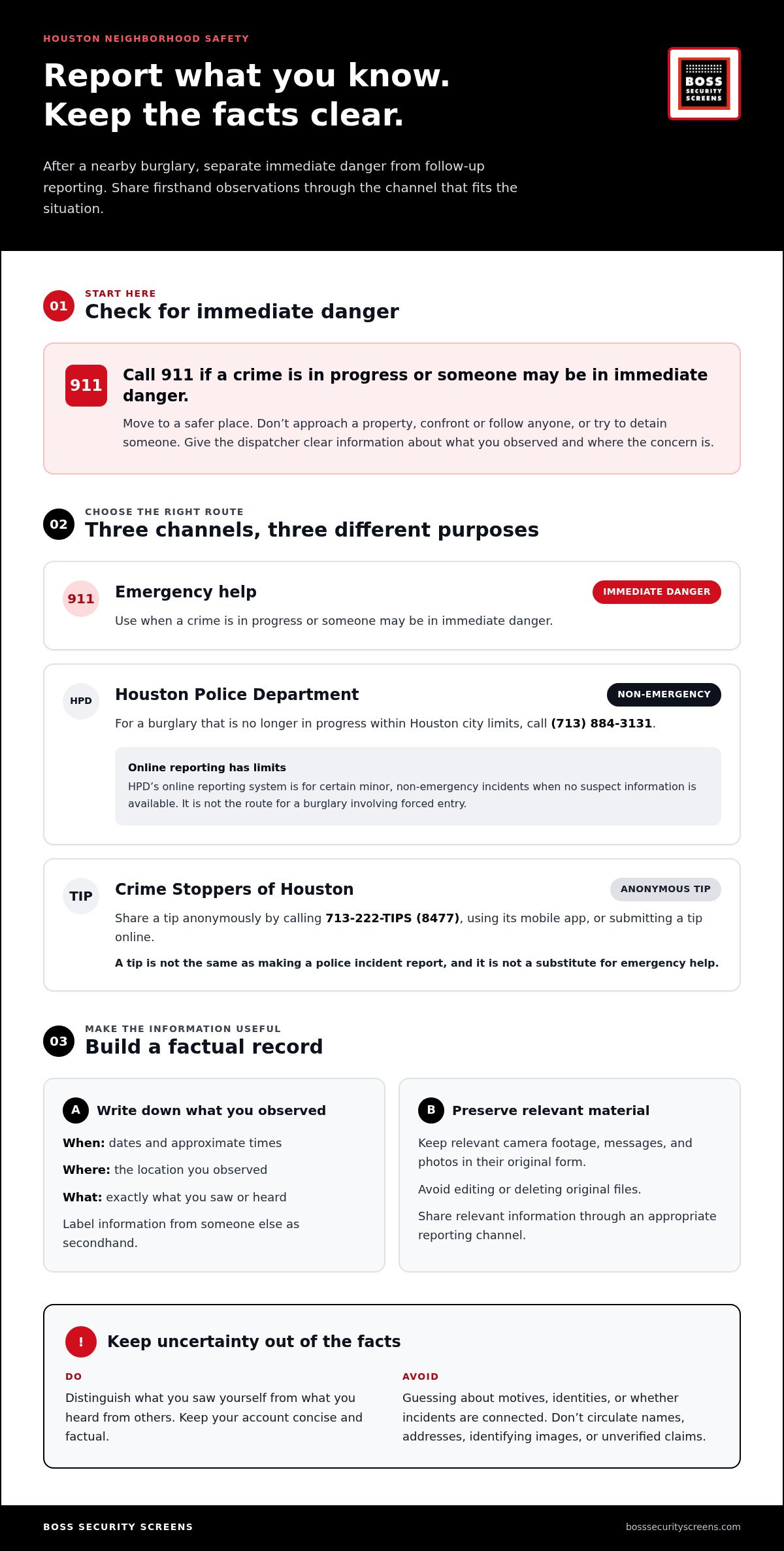
Use this order if you’re unsure what to do after a neighborhood burglary Houston neighbors have reported:
Assess immediate danger. If you see signs that someone may still be inside or nearby, don’t approach the property.
Call for emergency help when needed. In Houston, call 911 if a crime is in progress or someone may be in immediate danger.
Gather information safely. Once there’s no immediate threat to you, note what you personally observed and share relevant details through appropriate official channels.
Don’t enter a home to check on it if you suspect an intruder could remain inside. Even a door that appears open or damaged isn’t an invitation to investigate. Keep your distance and let emergency responders handle the situation.
If there may still be an immediate threat
Move to a safer place, such as inside a secure nearby building, and call 911 if danger may be ongoing. Don’t confront, follow, or try to detain anyone. If you’re already in a safe location, stay there and give the dispatcher clear information about what you observed and where the concern is. Avoid guessing about a person’s identity or intentions.
If the burglary happened nearby, not at your home
Separate confirmed details from neighborhood rumor. Don’t name a suspected person or repeat an address as fact unless the information has been verified through an appropriate source. Neighbors who saw something relevant can share their own observations through official channels. A nearby incident is a reasonable prompt to review household routines, not proof of a specific threat to your home.
For context, Burglary covers general usage and related concepts, but neighbors don’t need to settle legal definitions before taking sensible safety steps. Focus on what you know firsthand: a time, a location, a sound, or a description you observed. Clearly distinguish those details from anything you heard from someone else.
That distinction keeps communication useful and measured. If you’re coordinating with neighbors, share verified observations without circulating names, photos, or claims that could misidentify someone. Don’t put yourself at risk to gather more information. Once immediate safety is addressed, document what you know and report it appropriately.
Document What You Know and Report It Through Houston Channels
Once there’s no immediate danger, make a clear record of what you personally know. Memories can blur as neighbors exchange updates, so write down observations while they’re fresh. When considering what to do after a neighborhood burglary Houston residents hear about, keep facts, secondhand information, and guesses separate from the start.
Make a useful, factual record
Note when and where you observed something, then describe exactly what you saw or heard. For example, record that you heard glass break at a particular time rather than assuming someone entered a home. If a detail came from another person, label it as secondhand. The key is to share firsthand observations clearly and distinguish them from what you learned from others.
Write down dates, approximate times, locations, and direct observations.
Save relevant camera footage, messages, or photos in their original form. Avoid editing or deleting the original files.
Keep private details out of public posts, including names, addresses, and identifying images.
Don’t guess about motives, identities, or whether separate incidents are connected.
Preserving material doesn’t mean you need to investigate or circulate it. Keep a copy available and share relevant information through an appropriate reporting channel. Public speculation can spread errors and expose personal information without making a report more useful.
Choose the right reporting route
For a crime in progress or immediate danger, call 911. For a burglary that’s no longer in progress within Houston city limits, the Houston Police Department’s non-emergency number is (713) 884-3131. Check the Houston Police Department contact page for current reporting guidance. The department’s online reporting system is for certain minor, non-emergency incidents when no suspect information is available. It isn’t the route for a burglary involving forced entry.
Crime Stoppers of Houston serves a different purpose. If you have a tip to share anonymously, you can call 713-222-TIPS (8477), use its mobile app, or submit a tip online. A tip is not the same as making an incident report to police, and it isn’t a substitute for emergency help. Choose the channel that fits what you know and the situation.
If you’re unsure which reporting option applies, use current HPD guidance rather than relying on a neighborhood group post. Keep your account concise and factual, and make clear which details you observed yourself. Reporting carefully helps prevent uncertainty from becoming an unsupported claim.
After urgent reporting and documentation are handled, consider longer-term steps for your own home at your own pace. If you’re thinking about reinforcing doors or windows, you can discuss entry-point protection for your home.
A Houston Neighborhood Burglary Checklist for the Next Day
The next day is a good time to turn scattered updates into a calm, useful plan. You don’t need to solve the incident or assume your home is at risk. Focus on what you can verify, what your household can review, and how to support neighbors without adding to the rumor mill. This checklist makes the question of what to do after a neighborhood burglary Houston residents are discussing easier to manage.
Save your own observations. Note when and where you saw or heard something, and keep firsthand details separate from what others told you.
Preserve relevant material. Keep original camera footage or messages in their existing form, and make a note of where they’re stored.
Review household routines. Talk through who is home at different times, how doors are secured, and how household members can communicate if plans change.
Share only verified information. Use a trusted neighborhood channel for relevant, non-sensitive updates, and direct incident information to the appropriate official channel.
Check in with affected neighbors. Offer practical help while letting them decide what personal details they want to share.
Coordinate without amplifying rumors
A neighborhood message can help people stay informed, but keep it specific and restrained. Share what you personally observed or a confirmed update, not a theory about who was responsible. Avoid posting names, home addresses, identifying images, or details that could expose someone’s privacy. If a neighbor has footage or notes that may be relevant, suggest preserving them and sharing them through an appropriate channel rather than reposting them publicly.
For general guidance on reporting a crime and finding local law enforcement contacts, USA.gov offers a useful reference. Use official guidance for reporting decisions. Neighborhood conversations are best kept to verified, practical updates.
Support directly affected neighbors
A simple check-in can help without putting anyone on the spot. Ask whether they need practical help, such as saving relevant footage or organizing observations, and respect their choice if they’d rather keep the incident private. If they’re documenting visible damage, encourage them to keep notes and records organized. For questions about coverage or claim steps, the affected resident should contact their insurer and follow the instructions tied to their policy.
For households considering a longer-term physical-security measure, security screen doors can be one option to explore after urgent matters are handled. A nearby incident is a prompt for a measured review, not proof that a particular home is being targeted. Keep the focus on steady routines, useful communication, and thoughtful decisions.
Review Your Houston Home’s Entry Points Without Panicking
A burglary in the neighborhood can be a reason to review your home, but it doesn’t prove that your house is at risk or that a particular entry point was involved. Keep two actions separate: neighborhood updates help you understand what’s been confirmed, while a physical review helps you decide whether your own doors and windows need attention. You can do the second calmly and on your own schedule.
Check the openings you use every day
Walk through the home and consider each opening as its own access point. Look at exterior doors, operable windows, and patio sliders. Check for visible damage, a latch that doesn’t engage as expected, or a routine that leaves an opening unsecured. This is a general household check, not an attempt to determine how a neighbor’s home was entered.
Notice visible damage or hardware that appears loose or doesn’t function normally.
Review which doors and windows household members use, and how they’re secured when everyone is home or away.
Write down concerns so you can address them methodically instead of reacting to unverified neighborhood claims.
If you’re looking at a property where a burglary occurred, don’t enter or handle anything that may be relevant to the incident. Leave the inspection and documentation to the people directly responsible for the property and its report. At your own home, avoid unsafe repairs. Note the issue and decide on an appropriate next step.
Consider physical protection that fits the opening
Monitoring neighborhood messages can keep you informed, but it doesn’t reinforce a door or window. If your review points to a physical-security upgrade, custom-built stainless-steel mesh security screens offer another layer at the opening. Each system is measured and built around the opening, and the mesh is designed to resist forced entry while preserving airflow, visibility, and natural light.
For windows, custom security window screens can be considered for openings you use regularly. Every screen features a 4-point locking system, and operable window screens use ADA-compliant egress latches. The right configuration depends on the opening and how your household uses it, so consider everyday access as well as reinforcement.
This is a practical step, not an assumption that your home will be targeted. Boss Security Screens is Licensed, Bonded & Insured, holds an A+ BBB Rating, and is 110% Made in USA. Systems are custom-built around each opening and include a 15-year No Worry Warranty on parts and labor. If you’re ready to discuss a tailored screen option, request a free consultation.
Build a More Reassuring Houston Home-Security Plan
Once immediate safety, reporting, and documentation are handled, you can decide whether a longer-term security upgrade makes sense for your household. A nearby burglary doesn’t mean your home is destined to be targeted. It can prompt a thoughtful review of the doors and windows you use every day and whether added physical protection would help you feel more secure.
What custom security screens can add
Custom-built stainless-steel mesh security screens add a protective barrier at doors and windows while allowing airflow, visibility, and natural light. Each system is measured and built around its specific opening, rather than treated as a one-size-fits-all fit. Security screen doors have no exposed hinges, and every screen features a 4-point locking system. The result is protection designed to work with everyday use and the look of your home.
Boss Security Screens has completed 18,000+ installations with zero successful break-ins. The company is Licensed, Bonded & Insured, holds an A+ BBB Rating, and is 110% Made in USA. Each system includes a 15-year No Worry Warranty on parts and labor. These details can help you assess a long-term option on its merits rather than making a rushed decision out of concern about a nearby incident.
Beautiful protection, custom-built for the home. Start by considering the opening, the way your household uses it, and the balance between physical security and everyday comfort. A security screen may be one part of a broader plan, alongside consistent household routines and functioning door and window hardware.
Take a calm next step with Boss Security Screens
If you’re weighing options, start with the openings you want to reinforce. A custom assessment can help identify a screen approach that fits those spaces and your household’s routines. There’s no need to treat a neighborhood incident as a reason to rush. Take the next step when you’re ready to explore a lasting solution.
Schedule a free consultation to discuss a custom assessment and free estimate for your home. Boss Security Screens installs nationally, serving homeowners in Las Vegas, Phoenix, Los Angeles, Riverside, Scottsdale, San Jose, Oakland, San Francisco, Irvine, San Diego, Orlando, Detroit, Chicago, Minneapolis, Albuquerque, Dallas, Houston, and Sacramento. Contact the team at 1-800-203-5644 or (702) 637-0255, email info@bosssecurityscreens.com, or visit bosssecurityscreens.com. When deciding what to do after a neighborhood burglary Houston residents are discussing, practical preparation can help restore a sense of control without turning concern into panic.
Choose One Practical Step Toward Greater Peace of Mind
A nearby burglary doesn’t have to dictate how you feel at home. Use what you’ve learned to make one thoughtful decision, whether that’s reviewing a daily routine or exploring a physical upgrade for an opening you want to reinforce. A steady plan is more useful than a rushed reaction.
If you’re considering custom-built security screens, discuss the openings and features that matter to your household. For help deciding what to do after a neighborhood burglary Houston residents have reported, request a free consultation to talk through a tailored option and estimate.
Call 1-800-203-5644 or (702) 637-0255, email info@bosssecurityscreens.com, or visit bosssecurityscreens.com. You can take the next step at your own pace and build confidence through practical choices that fit your home.
Frequently Asked Questions
What should I do first if I think a burglar may still be nearby?
Move yourself and anyone with you to a safer place, and don’t approach the property or confront, follow, or try to stop anyone. If there’s immediate danger or a crime may still be in progress, call 911. Don’t enter the affected home or try to investigate from nearby. Give emergency services clear information about what you observed, then follow their current instructions.
Should I touch anything if my own Houston home was broken into?
First, make sure everyone is safe, and avoid moving or handling items that could be relevant to the incident. From a safe position, you can note visible damage, such as a broken window or damaged door, without entering an area where you feel unsafe. Follow current police instructions about next steps, and contact your insurer for guidance specific to your policy and situation.
How should I share security-camera footage after a neighborhood burglary?
Keep the original recording unchanged, and note the date and time shown by the camera, including any uncertainty about its clock. Share relevant footage through an appropriate official channel, following current Houston reporting guidance rather than assuming every incident uses the same process. Don’t edit clips into a shorter version for public posting, accuse an identifiable person, or circulate footage that exposes private details.
Should I report a burglary that happened to a neighbor, not me?
If you directly saw or heard something relevant, you can share that observation through the appropriate current reporting channel without investigating further. For an emergency or crime in progress, call 911. For a past incident within Houston city limits, HPD lists (713) 884-3131 for non-emergency calls. A Crime Stoppers tip is separate from an incident report. Check current Houston guidance to choose the right route.
What should I do if a neighbor’s burglary has left me feeling unsafe at home?
It makes sense to feel unsettled, but a nearby burglary doesn’t establish that your home faces a specific threat. Review routines that matter to your household, such as locking doors when leaving and knowing how family members will communicate if plans change. Note practical concerns at your own entry points and discuss verified information with trusted neighbors. If distress persists or disrupts daily life, consider reaching out for support.
Can security screens help after a burglary in the neighborhood?
Custom-built stainless-steel mesh security screens can reinforce a door or window while preserving natural light, airflow, and visibility. Each system is measured around its opening and features a 4-point locking system. Screens are engineered to resist forced entry and heavy impact. They’re one possible longer-term physical-security measure, not a substitute for emergency help, reporting, or other immediate safety steps. Consider them as part of a measured home-security plan, based on the openings your household wants to reinforce.

Article by
James Kerr
James is Founder / CEO of Boss Security Screens.