Riverside Home Security Improvement Costs
Riverside home security improvement costs for 2026 depend on what you’re securing and whether you install equipment yourself.
It makes sense to weigh the initial cost against the work involved and any ongoing expenses. A lower upfront price may suit a simple setup, while professional installation can help with a more involved system.
This guide explains how to compare security upgrades and prioritize your budget. For doors and windows, Boss Security Screens provides custom-built security screens with professional installation, a practical option when your priority is strengthening physical entry points.
Key Takeaways
- Compare DIY and professional installation by looking beyond upfront equipment to installation work and ongoing monitoring costs.
- Keep spending focused by prioritizing the entry points you want to secure and adding equipment in stages.
- Explore Riverside County assistance and possible insurance discounts, while paying close attention to eligibility requirements.
- Choose improvements that address a specific vulnerability, rather than paying for features your household may not need.
- Factor in recurring charges, activation fees, permits, and contract terms when estimating the full cost of an upgrade.
DIY versus professional installation
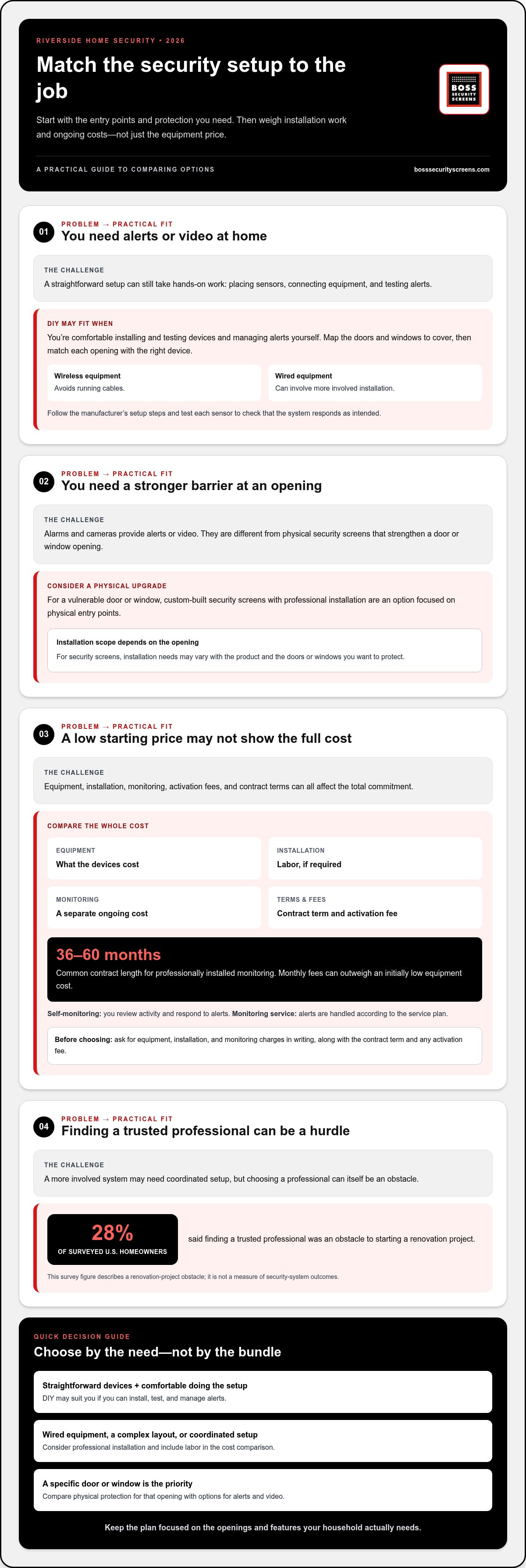
DIY alarms and cameras differ from professionally installed physical security screens. For Riverside homeowners, the right approach depends on whether you need alerts and video, a stronger barrier at an opening, or both.
DIY can be an affordable choice when the system is straightforward and you’re comfortable placing sensors, connecting equipment, and testing alerts. A practical first step is to map the doors and windows you want covered, then match each opening with the right device. Wireless equipment avoids running cables, while a wired system can involve more involved installation. Follow the manufacturer’s setup steps and test each sensor so you know the system responds as intended.
Professional installation adds labor to an alarm or camera system’s equipment costs, particularly when wiring or several devices are involved. If you choose security screens, installation needs may vary with the product and opening. The scope depends on which doors or windows you want to protect.
Monitoring is a separate ongoing cost, not the same as installation. With self-monitoring, you review system activity and respond to alerts yourself. A monitoring service handles alerts according to its plan.
Compare the full commitment before choosing. Professionally installed monitoring contracts commonly last 36 to 60 months, so monthly fees can outweigh an initially low equipment cost. Ask for the total equipment, installation, and monitoring charges in writing, along with the contract term and any activation fee. Finding a trusted professional can also be a hurdle: in a U.S. homeowner survey, 28% said it was an obstacle to starting a renovation project.
- Prefer DIY if you can install and test the devices and want to manage alerts yourself.
- Consider professional installation for wired equipment, complex layouts, or systems that need coordinated setup.
- Compare total costs by adding equipment, installation, monitoring, and contract commitments.
Ways to keep security costs affordable
Keep your budget tied to the protection you actually want. For Riverside home security improvement costs in 2026, compare a focused plan with a broader one before deciding what to buy.
Rebates, Grants, and Insurance Discounts
Keep possible assistance separate from the amount you plan to spend. Riverside County programs and insurance discounts apply to different types of improvements, so don’t assume a security purchase qualifies. Describe the proposed work clearly and distinguish changes to the home from alarms, cameras, or other equipment.
Compare a budget based on funds you can rely on with a separate version that includes possible assistance. Make sure the essential improvement is affordable without uncertain funding, and treat any grant or insurance savings as a possible offset rather than money already available.
Risks and Hidden Upgrade Costs
Subscriptions can strain a budget after installation. In the 12 months before a U.S. survey, 8% of renters canceled or downgraded a home security subscription because of rising costs. Before adding a paid feature, decide whether you’ll use it regularly and whether it addresses a specific need.
Renters can also avoid spending on equipment that doesn’t fit their living situation. In the previous 12 months, 16% of surveyed U.S. renters delayed upgrades or additions because of rising costs. Choose a small, portable setup that suits the current home, and avoid expanding it simply because extra devices are bundled together.
Upfront equipment cost influenced product choices for 24% of surveyed U.S. users. Use that concern to set a firm spending limit before comparing options. List the protection you need, rank each item by importance, and postpone lower-priority purchases until the essentials fit your budget.
For Riverside home security improvement costs in 2026, leave room in your plan for changing priorities. A household may decide to add coverage after living with its initial setup, or remove features that go unused. Review the plan after installation, note which devices serve a clear purpose, and direct future spending toward remaining gaps.
For physical protection at a vulnerable door or window, discuss your security priorities and the openings you want protected.
Some useful security steps require little ongoing spending. Pick up mail and packages regularly to reduce signs that a home is unattended. Include these small upkeep expenses in your budget so routine maintenance doesn’t become an unexpected reason to leave equipment inactive. Local storage may also help you weigh equipment costs against recurring service charges when comparing setups.
Cost concerns can affect whether improvements happen at all: high costs were an obstacle preventing 54% of surveyed U.S. homeowners from starting a renovation project. Monthly cost was an important factor when choosing home security products for 46% of surveyed U.S. users. When considering an upgrade, check both the purchase price and any continuing charges, then choose an option that remains manageable over time. If a project feels too expensive as a whole, focus first on the most important protection and consider affordable habits or maintenance before expanding the setup.
Are there Riverside or California rebates, grants, or insurance discounts for home security improvements?
Riverside homeowners can explore county assistance and insurance savings, but the options serve different purposes. The Riverside County Home Enhancement Grant Program supports eligible exterior and functionality improvements; it is not a general rebate for security equipment. Review the proposed work against the program criteria before including grant funds in your budget.
For FY 2026, household income must be at or below 80% of County Median Income. Riverside County’s low-income limits are $68,900 for one person, $78,750 for two, $88,600 for three, $98,400 for four, and $106,300 for five. The limits shown for Riverside County took effect June 1, 2026. Compare the correct household size and income with the applicable limit.
Applicants must have occupied the home as their primary residence for at least one year before applying, and the program is for homeowners living in single-family homes. The home must be the applicant’s only real property. Eligible properties can include stick-built, manufactured, or modular homes affixed to the owner’s private property.
Property insurance is another eligibility requirement. Riverside County requires a valid policy for eligible homes, including flood coverage when a home is in a flood zone. An inspection can lead to denial if substantial improvements will not result or rehabilitation is not cost-effective for the homeowner or County. Clearly describe the proposed exterior work and its practical benefit.
Insurance discounts follow a separate process. Some homeowners policies offer discounts for monitored alarms, smoke and carbon monoxide detection, or video surveillance. Ask your insurer how the specific protection affects your policy, what documentation is needed, and whether a discount applies to your coverage. A discount affects insurance costs, not the purchase price of equipment.
Use this sequence to assess possible savings:
- Compare household income and size with Riverside County’s FY 2026 limits.
- Check occupancy, property ownership, home type, and insurance requirements.
- Describe the proposed improvement clearly for program eligibility review.
- Ask your insurer which installed protections qualify under your policy.
Corona Housing and Development also offers low-interest loans and home-improvement grants to income-qualified homeowners, seniors, and mobile-home owners. Because this assistance covers more than security upgrades, consider the project’s purpose and applicant eligibility before including it in a funding plan. Keep grant support and insurance savings separate, and build your budget around the improvements themselves.
Which home security improvements offer the best value for Riverside homeowners and renters?
The best value comes from matching each improvement to a specific security gap. In Riverside, compare the scope of a targeted upgrade with a broader system, then prioritize the entry points that matter most. Custom security screens from Boss Security Screens can address vulnerable doors and windows without serving as a substitute for alarms or cameras.
Start with entry sensors if doors or windows need monitoring. A practical order is to list vulnerable entry points, cover those first, then consider motion detection where it adds useful coverage.
Cameras provide visibility rather than a physical barrier. Decide what you need to see: a camera can cover a selected area, while a video doorbell focuses on activity at the front entrance. Choose the view that fills a specific gap, and consider a security screen when the concern is physical access through a door or window.
For homeowners, a coordinated setup can make sense when several entry points need coverage. A homeowner might begin with sensors at priority doors, then add a camera or protective security screens if visibility and physical reinforcement remain a concern.
Renters may prefer a smaller, adaptable arrangement focused on the front door or accessible windows. A sensor or camera can address one priority without requiring a comprehensive system. Consider installation requirements and household routines before choosing equipment, and select devices for a specific need rather than simply choosing a larger package.
Use this quick comparison to set priorities:
- Entry Sensors: Best for monitoring doors and windows with minimal upfront cost.
- Security Screens: Ideal for adding physical strength to vulnerable entry points without blocking natural light or airflow.
- Security Cameras: Useful for active monitoring and recording visual activity around the property.
For either a rental or owned home, compare each device with the coverage it adds. A focused combination of sensors, cameras, and reinforced Boss Security Screens may be more useful than a larger package with overlapping features. Make improvements in stages, starting with the entry or viewing point that matters most to your household safety.
What common risks or hidden costs affect home security upgrades in Riverside?
The total scope of a security upgrade can extend beyond equipment. In a Riverside home, consider installation, compatibility, monitoring terms, and upkeep. Separate one-time expenses from recurring commitments when comparing alarms and cameras. For physical openings, Boss Security Screens custom-builds and professionally installs security screens for doors and windows.
Start by assessing the property. A camera plan for a front entrance differs from one covering a detached garage or side gate. Each location may require equipment, power access, or additional installation work. Sketch the areas you want to monitor and note existing wiring, outlets, and network access before choosing a system. For doors and windows, identify the openings you want to strengthen.
Compatibility can affect an alarm or camera budget. A new sensor may not work with an existing hub, and a camera may need separate storage or monitoring. List your current devices and their connection requirements before expanding the system. For physical security, match the screen to the specific opening, since each product is custom-built to fit.
Placement affects how useful a system is. A motion sensor aimed at a busy walkway may trigger unwanted alerts, while a poorly positioned camera may miss the view you need. Give each device a clear purpose, such as monitoring an entry or viewing a particular approach, and review coverage before buying duplicates. For physical protection, focus on the doors and windows that need a stronger barrier.
Review service terms separately from equipment and installation. Compare any activation charges, monitoring fees, and cancellation terms in writing. A low initial payment can be offset by recurring fees or contract commitments over time. Check whether a plan includes services you do not need and how it handles changes or cancellation.
Use this checklist before approving a project:
- Map coverage: mark each door, window, gate, and camera viewpoint.
- Check compatibility: compare proposed equipment with devices already installed.
- Clarify the scope: separate equipment, labor, activation, and recurring services.
- Review upkeep: identify batteries, storage, or other items requiring replacement.
- Read terms: record monitoring commitments and cancellation conditions.
For Riverside homes where a vulnerable entry needs a physical security improvement, discuss your security priorities and the openings you want protected. A defined scope makes it easier to compare the right improvement with electronic devices and avoid paying for overlapping coverage.
For physical protection, Boss Security Screens custom-builds and professionally installs security screens for doors and windows. The right option depends on the opening and the type of access you want to secure.
Some home security companies charge early contract termination fees of 75% to 100% of the remaining contract balance. Ask for the applicable cancellation terms in writing and compare them with any monitoring commitment. This can help you understand costs that may arise if your needs change.
Boss Security Screens: Security Screens
Boss Security Screens helps Riverside homeowners strengthen vulnerable doors and windows with professionally installed security screens. If your priority is a physical barrier at an entry point, rather than cameras or monitoring, this can be a practical part of your home security plan.
Choose Security Screen Doors, Security Window Screens, or Sliding Security Doors to suit the openings you want to protect. The best fit depends on your home’s layout and which doors or windows need attention. These custom-built improvements focus on physical access points and can complement electronic security systems.
For a clearer next step, note the openings you’re concerned about and discuss the options with Boss Security Screens. Contact the team to talk through your home security needs.
Make Your Next Security Decision With Confidence
Turn your security priorities into a plan that fits the way you use your home. Start by identifying the entry point you want to address first, then decide whether a physical improvement belongs alongside your existing devices. That practical focus can make Riverside home security improvement costs in 2026 easier to assess against the protection you want to add.
For doors and windows, Boss Security Screens offers Security Screens, Security Screen Doors, and Security Window Screens. These options address physical openings, complementing electronic equipment rather than replacing monitoring or alarms. A clear conversation about your home’s layout can help you consider which openings deserve attention and what kind of improvement suits them.
When you’re ready to discuss your priorities, contact Boss Security Screens. A thoughtful next step can help you move from cost questions to a more secure, comfortable home.
Frequently Asked Questions
What is the average cost of home security upgrades in Riverside, California, in 2026?
For context, the U.S. That figure is a benchmark, not a Riverside-specific quote or a price for every kind of upgrade. A Riverside project’s total depends on whether you’re adding devices, changing entry points, or combining equipment. Separate system equipment from installation and ongoing services when estimating your own project.
What do security doors, window locks, and window bars cost in Riverside?
There isn’t one useful price for all three improvements because each project has different materials and installation needs. A security door’s cost depends on the opening and chosen door configuration. Window-lock work depends on the existing window and compatible hardware, while bars depend on the opening and mounting requirements. For Riverside budgeting, define which openings need protection and compare the scope of each improvement before choosing.
How do DIY and professional home security installation costs compare in Riverside?
For a fair comparison, add equipment and labor separately, then consider whether the layout requires wiring or a more involved setup.