Powder Coated Aluminum Security Frames: What to Know Before Choosing
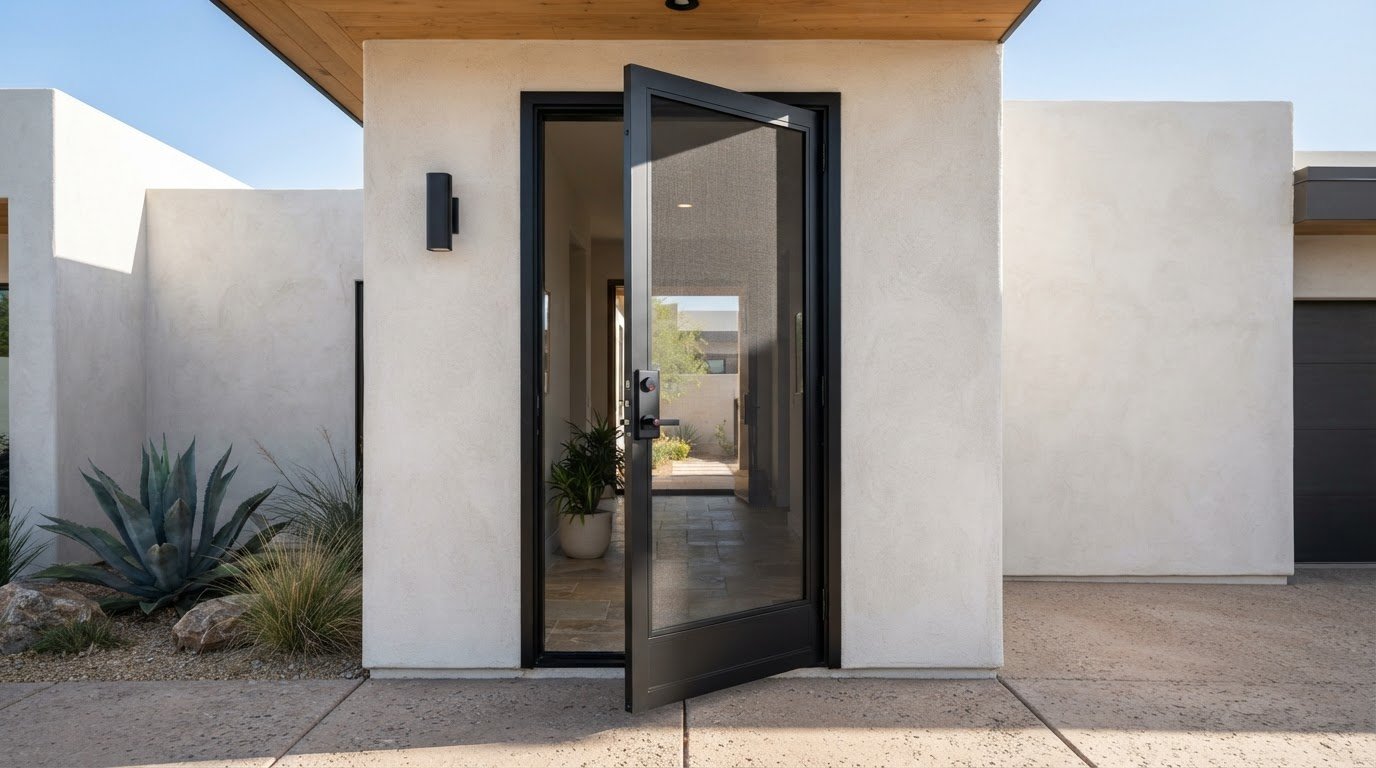
Does a powder-coated frame tell you how secure a screen will be? Not by itself. Powder coated aluminum security frames have a finished surface, but the coating isn’t the mesh, the lock, or the custom fit that helps protect an opening.
It makes sense to look closely at a frame’s finish. Wear, corrosion, fading, and chipping are common considerations, and product descriptions don’t always make it easy to compare what each feature does. The key is to distinguish the finish’s role from the security performance of the complete screen.
This guide explains what powder coating contributes to an aluminum frame, what it doesn’t tell you, and which parts of a security screen to assess. You’ll see how the frame, stainless-steel mesh, locking system, custom measurement, and installation work together. Boss Security Screens custom-builds and professionally installs screens for individual openings, combining aircraft-grade aluminum frames with powder-coated finishes and stainless-steel mesh. Assess the complete system, not just one material claim, and consider how it will suit your home while preserving natural light, airflow, and visibility.
Key Takeaways
- Powder coated aluminum security frames have a protective finish, but powder coating itself isn’t a security rating or a measure of forced-entry resistance.
- Compare the complete screen system: frame, finish, stainless-steel mesh, locking system, custom measurement, and installation.
- Consider how the finish’s color and appearance will suit your home. Don’t assume a coating description guarantees a specific lifespan or level of security performance.
- Start with the opening, how you use it, the screen configuration, and your appearance priorities. Custom measurement helps ensure the screen is built around the opening.
- Boss screens feature aircraft-grade aluminum frames, powder-coated finishes, stainless-steel mesh, a 4-point locking system, and no exposed hinges. The 15-year No Worry Warranty covers parts and labor. Boss is Licensed, Bonded & Insured, has an A+ BBB Rating, and states 110% Made in USA.
What Are Powder Coated Aluminum Security Frames?
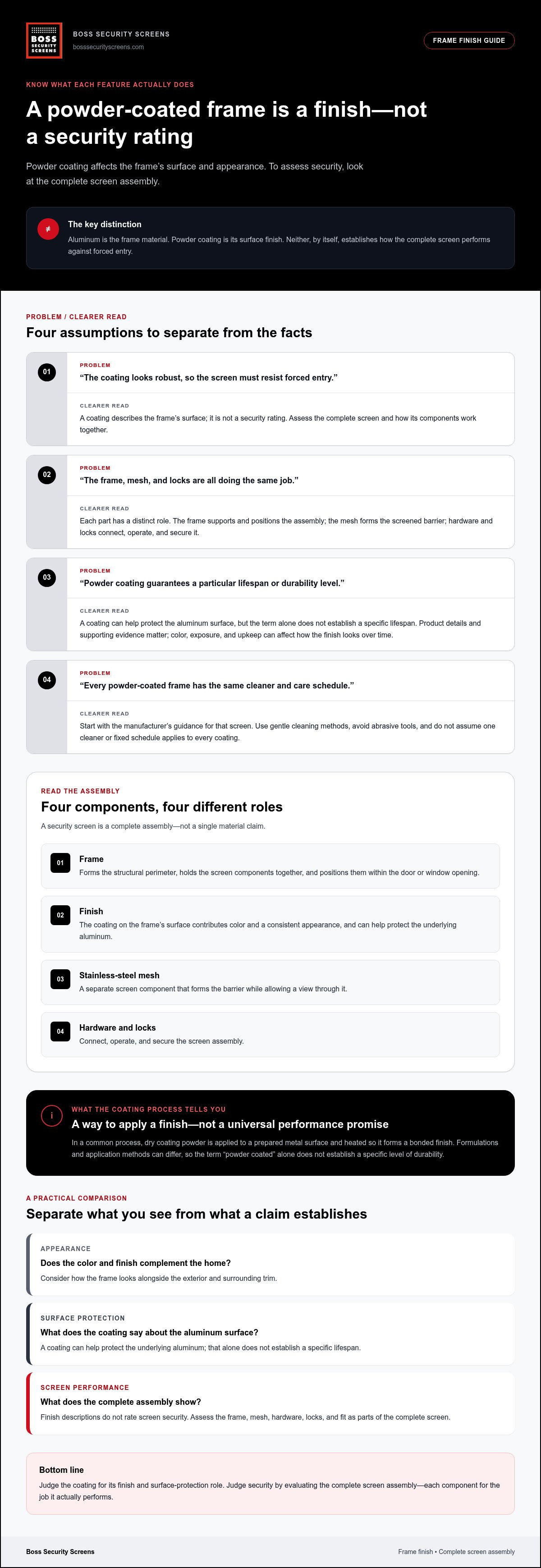
A security screen is a complete assembly, not a single material. The frame forms its structural perimeter, holding the screen components together and positioning them within a door or window opening. Mesh, hardware, and locking points each have separate roles. Looking at these parts individually helps you understand product descriptions and avoid mistaking a finish claim for a security rating.
A powder-coated frame combines an aluminum frame with a protective, colored finish. Aluminum is the frame material; powder coating describes its surface finish. The finish contributes to the screen’s appearance and helps protect the underlying surface, but it doesn’t establish how the complete screen performs against forced entry.
Simple security-screen assembly
Frame: The perimeter that holds the assembly and fits within the opening.
Finish: The coating on the frame’s surface, providing color and a consistent appearance.
Stainless-steel mesh: A separate screen component that forms the barrier while allowing a view through it.
Hardware and locks: Components used to connect, operate, and secure the screen assembly.
What does powder coating mean on an aluminum frame?
Powder coating is a way to apply a finish to metal. In a common process, dry coating powder is applied to a prepared surface and heated so it forms a bonded finish. Formulations and application methods can differ, so the term alone doesn’t establish a specific level of durability. For a plain-language overview of the process, see What is powder coating?
For a homeowner, the visible benefit is color and a more uniform appearance across the frame. The finish can help the frame complement a home’s exterior and protect the metal underneath. However, not every coating has the same properties or performs identically in every environment. Those details depend on the specific product.
How is the frame different from the security mesh?
The frame holds the screen assembly and helps it fit the opening. The mesh is a distinct component within that perimeter. Stainless-steel mesh forms the screen’s barrier while allowing a view through it. Its construction is separate from the frame’s material and finish.
Hardware and locks matter, too. They connect and secure the assembly, while the frame supports its shape and the mesh fills the screened area. A powder-coated finish may look robust, but it doesn’t replace an assessment of those other components. Aluminum or a coating alone doesn’t prove forced-entry performance. Evaluate how the components work together as a complete security screen, with each feature judged by the role it actually performs.
How Powder Coating Affects Aluminum Frame Appearance and Upkeep
A frame’s finish is one of the first details you notice. Its color and surface can help a security screen sit comfortably alongside a home’s exterior rather than look like an afterthought. A consistent finish also gives the frame a unified appearance, viewed from indoors or outside.
The finish has a practical role, too. A coating can help protect the aluminum surface, but that broad benefit shouldn’t be confused with a promise about how long a particular finish will look new or how it will perform in every setting. Powder coating describes the frame finish, not the security rating of the screen. The finish is one consideration. The complete screen’s construction and components determine its security performance.
What durability claims can a coating support?
Powder coating identifies a type of finish, not a universal performance level. Specific claims depend on the product and the evidence available for it. Color, exposure to the elements, and upkeep can affect how a finished surface looks over time, so don’t assume a general coating description proves a particular result. When comparing products, look for product-specific information and be cautious about lifespan or performance figures that aren’t tied to the product.
For a practical comparison, separate what you can see from what a product claim establishes:
- Appearance: Consider whether the color and finish complement the home’s exterior and surrounding trim.
- Surface protection: A coating can help protect the underlying aluminum, but that alone doesn’t establish a specific lifespan.
- Performance: Finish descriptions don’t rate the screen’s security. Evaluate the complete assembly separately.
How should a powder-coated frame be cleaned?
Keep care simple and follow the manufacturer’s instructions for the specific screen. Gentle cleaning is a sensible general approach. Avoid abrasive methods that could scratch or wear the finish, and don’t assume a particular cleaner or fixed schedule applies to every coating. If care guidance comes with the product, follow it rather than relying on a one-size-fits-all rule.
- Use the product’s care guidance as your starting point.
- Choose gentle cleaning methods and avoid abrasive tools.
- Include the frame in routine appearance care, but don’t treat cleaning as a substitute for assessing the rest of the screen.
These distinctions matter when comparing powder coated aluminum security frames. A finish can support a polished look and help protect the frame’s surface, but color and coating claims don’t tell you how the mesh, locks, hardware, and fit work together. If you’re considering a screen for your home, discuss a custom security screen for your opening and weigh appearance alongside the complete system.
Aluminum Frame Finish vs. Complete Security Screen Performance
A product description can name strong materials and an attractive finish without explaining how the full screen works. Separate specifications by component. This helps you identify whether a claim describes the frame’s appearance, the mesh barrier, the locking hardware, or how the assembly fits the opening.
| Component | What the specification describes | What it doesn’t establish on its own |
|---|---|---|
| Frame material | The structure around the screen assembly. Boss uses aircraft-grade aluminum frames. | Security performance of the complete screen. |
| Frame finish | The coating and appearance applied to the aluminum frame. | A security rating or proof that the screen resists forced entry. |
| Mesh | The screen material within the frame. Boss uses stainless-steel mesh. | How the frame fits or how the lock operates. |
| Locks and hardware | The components that secure and operate the screen. Boss screens include a 4-point locking system. | The finish quality or fit of the assembly. |
| Measurement and installation | How the complete screen is sized and fitted to its opening. | The material or finish specifications of each component. |
These details work together, but they aren’t interchangeable. A powder-coated finish describes the frame’s surface. It doesn’t describe the mesh, locking points, or installation. Likewise, a mesh specification doesn’t tell you how the screen has been measured to fit a particular window or door.
Which specifications describe the frame, and which describe the screen?
Aluminum and powder coating are frame attributes: one names the frame material, and the other its finish. Stainless-steel mesh and locking hardware are separate parts of the system. Fit matters as well. Boss custom-builds screens around each opening and professionally installs them, matching the assembly’s dimensions to the space it’s designed to protect. Read each specification in its proper context.
Does a powder-coated frame prove a screen is secure?
No. Finish type alone doesn’t establish forced-entry performance. A coating may contribute to the frame’s appearance and surface protection, but it isn’t a measure of how the complete assembly responds to force. Boss security screens are engineered to resist forced entry and heavy impact. The frame, stainless-steel mesh, locking system, custom measurement, and professional installation all belong in the evaluation.
Assess security screens as complete assemblies, not by frame finish alone. That’s the useful distinction when comparing powder coated aluminum security frames: frame material and finish tell you about the perimeter, while mesh, locks, and fitted installation describe other parts of the system. Look at how the specifications work together, then judge each claim by the component it actually covers.
How to Evaluate Powder Coated Aluminum Security Frames for Your Opening
Start with the opening, not the finish sample. A frame should suit the space it’s built for, how you’ll use it, and the look you want from indoors and outside. These steps can help you compare options without letting color or coating claims stand in for a properly fitted security screen.
- Identify the opening. Note whether you’re securing a window, hinged door, sliding door, or patio slider. Each opening has its own dimensions and operating pattern. For a window, consider custom security window screens built around that opening.
- Define the intended use. Think about how the opening works in everyday life. A screen for a frequently used entry needs to suit normal door operation; a window screen should fit the window and how you use it. For entryways, explore security screen doors designed for door openings.
- Set your comfort priorities. Consider how you want the screen to balance visibility, airflow, and natural light with the security you need. Note practical details, too, such as whether the door or window must open and close smoothly as part of your routine.
- Choose the visual direction. Compare the frame’s color with exterior trim, nearby finishes, and the property’s overall character. A finish that complements the home can make a protective screen feel like a considered part of the design.
What should you consider before selecting a frame finish?
Look at the full exterior rather than choosing a color in isolation. The frame sits alongside siding, trim, glass, and other visible details, so decide whether you want it to blend in or create contrast. Boss offers custom color and configuration options, so you can consider the screen’s appearance alongside how it needs to fit and function. The right priorities depend on the opening and your home.
How does custom measurement shape the final fit?
Measurements connect the screen design to the actual opening. Boss professionally measures and custom-builds each screen around that opening, then installs the finished system. This matters because a window, hinged door, and patio slider have different uses and configurations. A screen intended for one type of opening shouldn’t be treated as a universal fit for another.
With powder coated aluminum security frames, the finish is one part of the decision. Match the configuration to the opening, set your appearance priorities, and consider how the screen will work in everyday use. Then assess the complete system, not just its color or frame material. Plan a custom security screen for your opening with Boss Security Screens.
Boss Security Screens: Custom Aluminum Frames, Finished for Your Home
A finished screen should fit the opening, suit the home, and bring its components together as one complete system. Boss Security Screens custom-builds and professionally installs security screens with aircraft-grade aluminum frames, powder-coated finishes, and stainless-steel mesh. Each screen is measured and built around its opening, helping the finished assembly fit the window, door, or patio access it’s designed to protect.
What does a custom-built Boss security screen include?
The frame provides a strong perimeter, while the powder-coated finish contributes a clean, coordinated appearance. Stainless-steel mesh forms the screen barrier while preserving natural light, airflow, and visibility. The complete system also includes a 4-point locking system. Operable screens use ADA-compliant egress latches where relevant to the opening, supporting access from inside.
Fit is part of the design, not an afterthought. A screen for a window has a different purpose and configuration from one used at an entry or patio slider. Custom measurement connects the screen’s dimensions to the actual opening, while professional installation completes the fitted assembly. Boss screens have no exposed hinges, keeping the design streamlined without confusing a polished appearance with the security features themselves.
That balance matters at home. You want a robust barrier, but you also want your space to feel open and comfortable. Boss’s stainless-steel mesh security screens are designed to preserve light, airflow, and visibility while providing security for the opening.
What reassurance comes with the finished installation?
Boss backs its security screens with a 15-year No Worry Warranty on parts and labor. The company is Licensed, Bonded & Insured, has an A+ BBB Rating, and states 110% Made in USA. Its record includes 17,000+ installations with zero successful break-ins. These are useful points to consider alongside the frame, mesh, locks, and custom fit.
The central takeaway is straightforward: a finish is one part of a complete security screen. Aircraft-grade aluminum frames and powder-coated finishes contribute to the frame and its appearance; stainless-steel mesh, locking hardware, custom measurement, and professional installation each have their own roles. Boss screens are engineered to resist forced entry and heavy impact, bringing those elements together in a system built around each opening.
Boss Security Screens serves homeowners in Las Vegas, Phoenix, Los Angeles, Riverside, Scottsdale, San Jose, Oakland, San Francisco, Irvine, San Diego, Orlando, Detroit, Chicago, Minneapolis, Albuquerque, Dallas, Houston, and Sacramento. Ready to consider a custom security screen for your home? Request a free consultation. Call 1-800-203-5644 or (702) 637-0255, email info@bosssecurityscreens.com, or visit bosssecurityscreens.com.
Take the Next Step Toward a Better-Fitted Screen
Choosing powder coated aluminum security frames is a chance to make a considered decision about how protection should work in your home. Before moving ahead, write down which opening you want to secure, what matters most in its everyday use, and how you’d like the finished screen to look. Clear priorities make it easier to discuss a solution that suits your household.
A conversation about the opening can help turn your requirements into a tailored plan for the screen and its installation. Request a free consultation, call 1-800-203-5644 or (702) 637-0255, email info@bosssecurityscreens.com, or visit bosssecurityscreens.com.
A secure home can still feel bright, open, and distinctly yours. Choose with confidence, and make the screen work for your home.
Frequently Asked Questions
What is a powder-coated aluminum security frame?
A powder-coated aluminum security frame is an aluminum perimeter with a colored coating bonded to its surface. In a security screen, it works alongside mesh, locks, hardware, and a measured fit. A product label naming the frame finish tells you about its surface, not how the full screen performs under force. Assess powder coated aluminum security frames as part of the complete assembly, with each component considered for its specific role.
Is powder coating better than paint for aluminum security frames?
Neither finish is automatically best for every frame. Compare the specific product’s finish details, intended setting, care guidance, and appearance rather than relying on the finish name alone. If you’re weighing two screens, assess those details separately from security features, then compare the mesh, locking hardware, fit, and installation. A coating description helps explain the frame’s finish, but it can’t replace information about how the complete security screen is constructed.
Does a powder-coated aluminum frame prevent break-ins?
No. A powder-coated surface alone doesn’t establish a screen’s resistance to forced entry. That depends on the complete assembly and its fit, including the frame, mesh, and locks. Boss Security Screens are engineered to resist forced entry and heavy impact. When comparing options, treat the coating as a finish detail, then evaluate security information for the installed screen rather than inferring protection from its color or coating.
Will a powder-coated security screen block light or airflow?
No. Boss Security Screens’ stainless-steel mesh is designed to preserve natural light, airflow, and visibility while blocking bugs and intruders. Consider how you use the opening: a window screen should preserve daylight and a view, while an operable door screen should suit normal entry and exit. The frame coating is separate from these mesh functions, so it doesn’t determine how much light or airflow the screen allows.
Can powder-coated aluminum security frames be made to fit custom openings?
Yes. Boss measures and builds each screen around its specific opening, with colors and configurations tailored to the project. Custom sizing is useful for unusual dimensions or openings that need a particular operating setup; a generic frame size may not align with the actual space. Measuring the window, hinged door, or slider connects the screen to the opening and helps it fit and operate as intended.
How do you maintain a powder-coated aluminum security frame?
Use gentle cleaning, follow the care guidance for the specific product, and avoid abrasive methods. Don’t assume there’s one cleaning schedule or chemical that suits every finish. Surface care and system upkeep are separate: cleaning the frame keeps it presentable, but doesn’t show whether the mesh, locks, or opening operation are working as intended. Keep the entire assembly in mind, not just the visible finish.
What warranty does Boss Security Screens provide?
Boss Security Screens provides a 15-year No Worry Warranty covering parts and labor. Request a free consultation, call 1-800-203-5644 or (702) 637-0255, email info@bosssecurityscreens.com, or visit bosssecurityscreens.com.