Scottsdale Commercial Property Protection for Campuses
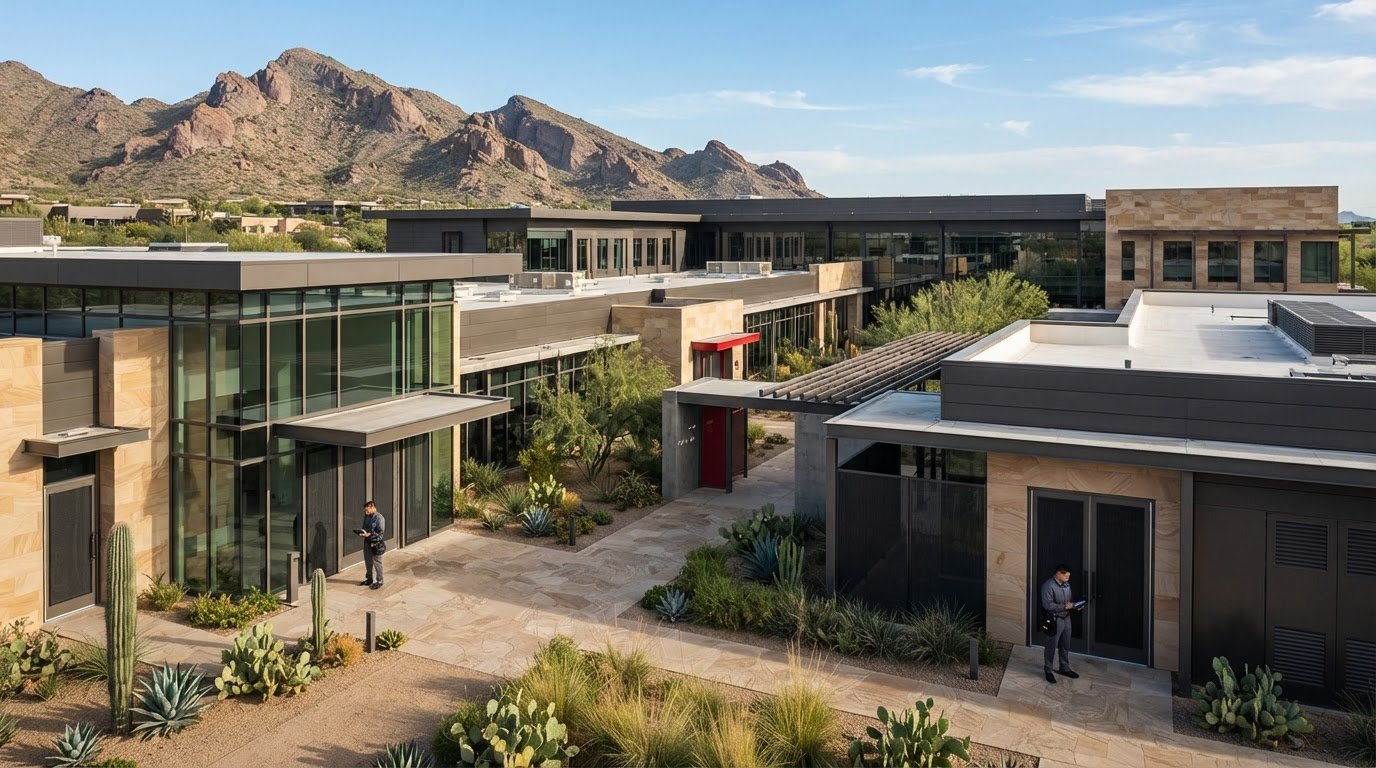
A campus is only as secure as its least-protected entrance. Effective Scottsdale commercial property protection starts with identifying how people move through the site, where doors and windows are vulnerable, and which openings need stronger physical barriers. A site-wide review turns those observations into practical priorities.
Corporate properties bring together offices, shared spaces, and busy access points, so one security measure may not address every exposure. Look beyond the main entrance and consider how the campus functions throughout the day.
This guide explains how to assess security needs across commercial campuses and corporate properties in Scottsdale, and what relevant provider experience looks like. You’ll learn which site details to consider, how to compare potential solutions, and how security screens can help protect vulnerable doors and windows. The goal is a clear, grounded plan that strengthens physical protection without losing sight of the property’s everyday use.
Key Takeaways
- Choose a provider with experience relevant to your property type and a strong claims track record.
- Assess how Scottsdale’s heat, wildfire exposure, and other local conditions could affect your campus.
- Map buildings, contents, and operations to identify what needs protection and where coverage gaps may arise.
- Review exclusions, deductibles, and off-site property needs so your protection reflects how the business actually operates.
- Consider security screens for vulnerable doors and windows as part of a broader physical security plan.
Choosing a provider with relevant experience
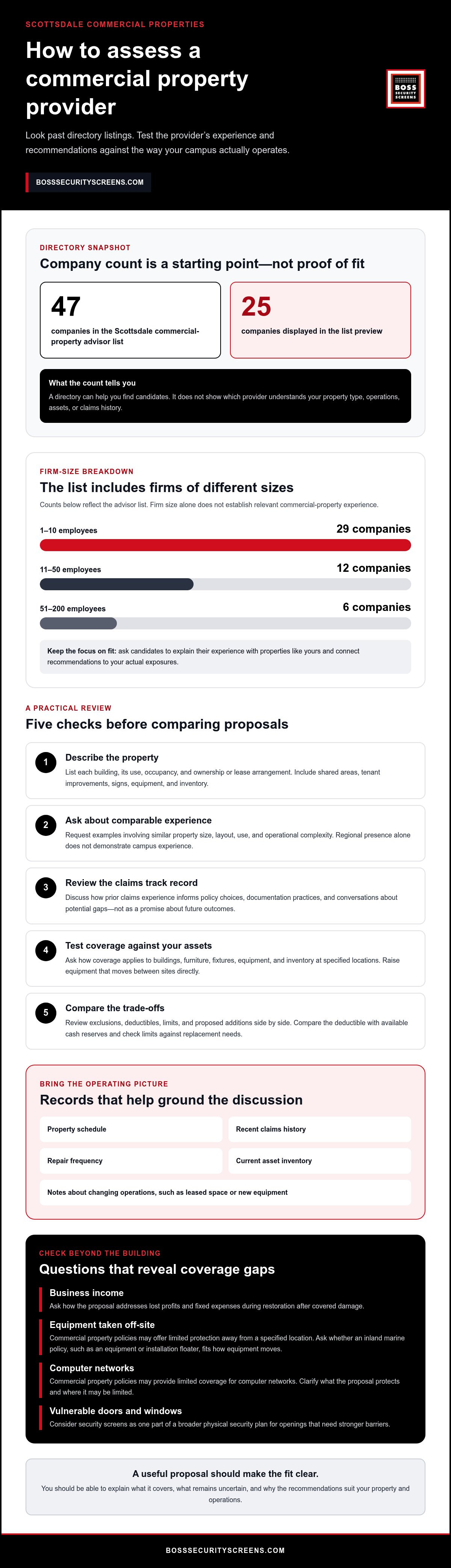
Start by matching the provider’s experience to the property’s actual use. A Scottsdale corporate campus may combine offices, shared entrances, equipment rooms, tenant spaces, and outdoor areas. An advisor familiar with a single storefront may not have the same experience assessing those connected exposures. For Scottsdale commercial property protection, look for a provider who can discuss your building type, operations, assets, and claims history in practical terms. Strong recommendations should connect specific risks to specific coverage decisions, not rely on a polished profile alone.
Use these steps to assess fit before comparing business insurance proposals:
- Describe the property. List each building, its use, occupancy, and ownership or lease arrangement. Include shared areas, tenant improvements, signs, equipment, and inventory. For example, a campus with multiple office buildings needs a different property discussion than one leased suite. The provider should use those details to explain which assets and locations a proposal addresses.
- Ask about comparable experience. Request examples of experience with properties resembling yours in size, layout, use, and operational complexity. A provider serving Phoenix businesses may understand regional conditions, but local presence alone doesn’t demonstrate experience with a corporate campus. Ask how that background informs coverage recommendations for buildings, contents, and business income.
- Review the claims track record. Discuss how the provider supports clients through claims and what types of claims experience inform its advice. The goal isn’t a promise about future outcomes. It’s a clear account of how prior claims patterns shape policy choices, documentation practices, and discussions about potential gaps.
- Test the recommendations against your assets. Ask the provider to explain how coverage applies to buildings, furniture, fixtures, equipment, and inventory at specified locations. If your business moves equipment between sites, raise that example directly. Commercial property policies may offer limited protection for property taken away from its specified location.
- Compare the trade-offs. Review exclusions, deductibles, limits, and any proposed additions side by side. Then compare the deductible with available cash reserves. A lower deductible changes the cost exposure at claim time, while a limit that overlooks replacement needs can leave a building underinsured.
Provider count alone can’t establish expertise. A Scottsdale commercial-property advisor list recorded 47 companies in total, with 25 displayed in its preview, as of October 10, 2026. Treat a directory as a starting point, not proof of fit. An independent comparison should focus on the provider’s experience, the proposed coverage, and how clearly each recommendation connects to your property profile.
Bring useful records to the discussion. A property schedule, recent claims history, repair frequency, current asset inventory, and notes about changing operations give the advisor a more grounded picture. For example, adding leased space or new equipment can change which locations and assets need attention. Past claims and regional weather trends can also help inform limits, deductibles, and add-ons.
Finally, check whether the advice covers more than the building’s physical structure. Business income coverage can help reimburse lost profits and fixed expenses during restoration after covered damage. A campus can face financial disruption even when repair work is concentrated in one building. Ask the provider to explain how the proposed plan addresses property damage, downtime, and the assets supporting day-to-day operations.
Also test the discussion against exposures that may sit outside the obvious building schedule. Businesses with equipment frequently taken off-site may need an inland marine policy, such as an equipment or installation floater. Ask the advisor to explain how that option would apply to the way your equipment moves, rather than assuming the property policy addresses every off-site exposure. Commercial property policies may provide limited coverage for computer networks, so ask the advisor to clarify what protection the proposal provides and where it may be limited. These questions can help show whether the recommendations account for your operations or rely on a standard approach.
The Scottsdale advisor list includes 29 companies with 1-10 employees, 12 companies with 11-50 employees, and 6 companies with 51-200 employees. Those figures show a range of firm sizes, but do not establish which advisor has relevant commercial property experience. Ask candidates to demonstrate their fit with examples and clear explanations. As you evaluate proposals, compare the deductible with your available cash reserves, and confirm that the limits and terms make sense for the assets and operations discussed. A useful final conversation should leave you able to explain what the proposal covers, what remains uncertain, and why the recommendations suit your property.
What risks are specific to commercial properties in Scottsdale and Maricopa County?
Scottsdale campuses face desert heat, wildfire exposure, storms, and security concerns. These conditions can affect buildings, outdoor assets, access points, and business continuity in different ways. Start with each property’s location, construction, use, and surroundings. Then connect each exposure to a practical protection decision instead of treating every building on campus as identical.
Wildfire is a regional consideration. Arizona experienced over 2,700 wildfires in 2021, which consumed nearly 400,000 acres of land. Those statewide figures don’t predict damage at a specific Scottsdale address. They do support reviewing each site’s surroundings and how a fire could affect access, operations, or nearby property. Map building locations, exterior storage, and entry routes. Note which operations rely on particular buildings, so disruptions can be considered alongside physical damage.
Heat is another direct operational stress. Extreme summer temperatures in Arizona often surpass 100 degrees Fahrenheit. For a campus, review how heat affects building use, stored inventory, equipment, and outdoor work areas. Identify assets kept in exposed locations and consider whether their placement or protection suits their function. Include operating plans in the review: a damaged or unusable space can disrupt work even when other buildings remain accessible.
Water deserves a careful, site-specific assessment. The Phoenix metro area averages 8.03 inches of rainfall annually, but an annual average doesn’t show how water moves across a particular property. Inspect grading, drainage paths, lower-level spaces, loading areas, and the locations of valuable equipment. Commercial property policies commonly exclude flood as a covered cause of loss, so separate flood coverage may be needed. Read the policy wording and compare it with the property’s flood exposure. A Scottsdale campus should not assume that ordinary property coverage addresses every type of water damage.
Storm damage can affect more than a roof. Outdoor signs, fences, landscaping, and exposed equipment may also be vulnerable. Walk the perimeter after reviewing site plans, and record where these assets sit relative to buildings and access routes. Check how wind-related damage is treated in the policy, including exclusions and limits. For example, a damaged sign could affect wayfinding or visibility even if the main building remains usable. Clear records help connect physical assets to operational needs.
Earthquake exposure also merits consideration. Arizona experienced a notable earthquake near Sedona in 2014. That event doesn’t establish the risk level for an individual Scottsdale property, but it makes earthquake coverage a sensible policy topic to evaluate. Consider the building’s construction, use, and the consequences of interrupted operations. Keep the review grounded in site details rather than assuming every structure has the same vulnerabilities.
Use a campus walk-through to turn these regional risks into an action list:
- Mark buildings, entrances, outdoor assets, and critical work areas on a site plan.
- Record where water collects, where equipment is stored, and which assets sit outside.
- Compare wildfire, heat, storm, flood, and earthquake exposures with policy exclusions.
- Identify doors and windows that need stronger physical protection as part of the site review.
For vulnerable openings on a commercial property, a security assessment consultation can help identify where commercial security screens may fit into the broader site plan.
The review can also distinguish the property’s characteristics rather than relying on a single description of the campus. Commercial property owners should assess a building’s location, age, type, construction, and use when identifying insurance risks. Consider each building on those terms and relate the assessment to the assets and activities already identified on site. This helps keep the insurance review connected to the actual property and its intended use, while making it easier to spot where a building’s characteristics call for closer attention. Keep the resulting notes with the site records and revisit them when the property or its use changes.
Policy wording needs the same deliberate attention as the physical inspection. Commercial property owners should review policy exclusions because hurricane damage may not be covered unless it is specifically included in the policy. Do not assume that a general description of property coverage resolves whether a particular cause of loss is included. Check the exclusions and any specific inclusion relevant to the exposure, then compare that wording with the property’s circumstances. Record questions that remain unresolved and seek clarification before treating a risk as insured. A clear written record of the building assessment and policy review can help owners make informed protection decisions and identify gaps that need further attention.
Commercial building
A commercial building review should connect the structure to the work inside it. For a Scottsdale office campus, that means looking beyond exterior walls. Building systems, tenant improvements, signs, mechanical equipment, and operating income can all shape the protection plan. Start with a building-by-building inventory. Record each property’s location, age, type, construction, and use. These details help reveal why two buildings on one campus may need different limits and coverage choices.
Next, distinguish the structure from its contents and improvements. A building owner may be responsible for the structure, while a tenant may have invested in interior improvements, furniture, or equipment. For example, a fitted office suite could contain tenant-funded fixtures alongside the landlord’s building systems. Identify who owns each item and where it is located. This makes it easier to decide how each asset should be included in the site’s protection plan.
Replacement cost deserves careful attention. A limit based on an outdated estimate can leave a building underinsured when rebuilding. Businesses that own commercial buildings can use a third-party appraisal to help determine current replacement cost. Keep that assessment distinct from the property’s market value. The relevant question is what it could take to replace the insured building, not simply what the property might sell for. Include major systems and permanent improvements in the review.
Then examine what a policy treats as covered property and covered causes of loss. Commercial property insurance commonly covers buildings, inventory, equipment, and tools against losses such as fire, break-ins, vandalism, and windstorms. Coverage can also extend to outdoor signs, fences, landscaping, and other people’s property, depending on policy terms. A sign damaged in a storm, for instance, may raise a different coverage question than damage to the building itself. Read each item against the policy wording.
Use this checklist to organize a building review:
- Structure: Record the building’s use, construction, and replacement needs.
- Systems: List mechanical equipment and other essential building systems.
- Improvements: Separate tenant improvements from owner-controlled property.
- Site assets: Note outdoor signs, fences, and landscaping.
- Operations: Identify how long a building outage could interrupt work.
Coverage options may address updated building codes or utility services failure or damage. Consider these against the building’s characteristics and operational dependencies. For example, an office that relies on utility service for essential systems faces a different interruption concern than a storage building. Review the policy’s stated limits and exclusions for each option. Don’t assume that an add-on applies to every location or every type of loss across a campus.
Physical repairs are only part of the financial picture. A policy focused on repairing a building may not address the impact of downtime. Consider how a damaged office, equipment area, or tenant space could affect operations while restoration takes place. Business income coverage may help with losses tied to covered damage, subject to the policy terms. Map critical functions to their locations, then compare the plan with the likely effect of losing access to each space.
Finally, connect the building assessment to visible access points. A commercial property review can include doors and windows as part of its physical protection plan. For a focused review of vulnerable openings, book a building security consultation and discuss how those areas fit the property’s needs.
Boss Security Screens: Security Screens
Boss Security Screens helps strengthen vulnerable doors and windows with custom-built commercial security screens, measured to fit each opening. On a campus, consider them where accessible openings need added physical protection, such as ground-level offices or shared entrances. Security Screen Doors and Sliding Security Doors protect door openings, while Security Window Screens are designed for vulnerable windows. Match the option to the opening and how people use the space, keeping access and daily operations in view.
These screens support a broader property plan, but they do not replace insurance or address risks such as flood, fire, or business interruption. They provide a physical layer of protection for specific openings where security matters. For Scottsdale commercial property protection, include them in a site-by-site review alongside the campus’s other security needs.
Contact Boss Security Screens to discuss security screens for your commercial property.
Make the next security decision a practical one
A campus security plan works best when it moves from broad priorities to specific openings. Choose one building or shared area, identify the doors and windows that need attention, and consider how each opening is used throughout the day. That focused starting point makes Scottsdale commercial property protection easier to put into action without losing sight of the wider property plan.
For physical protection at vulnerable openings, Boss Security Screens offers Security Screens, Security Screen Doors, and Security Window Screens. The right option depends on the type of opening and how the space is used. A considered choice can support a more secure workplace while keeping access and appearance in view.
Take the next step by discussing the openings you want to protect and how they fit your campus. Contact Boss Security Screens to discuss your property’s security needs. A clear starting point helps you move toward a more considered protection plan with confidence.